

How to Run a Food Waste Audit in Your Miami Kitchen
A food waste audit shows what your kitchen throws out and why. Here's a simple one-week plan for Miami restaurants and hotels, plus how to use results.
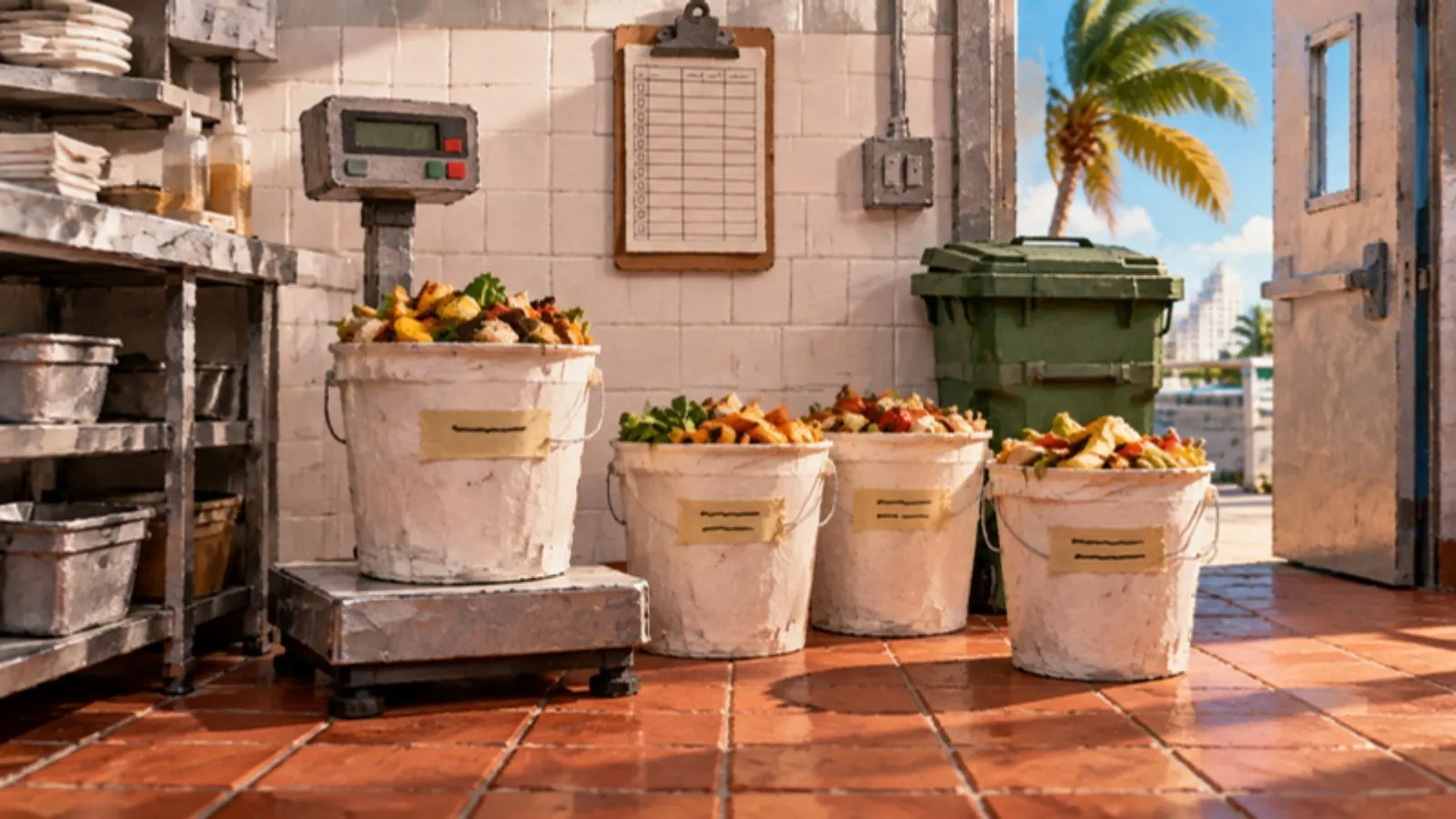
Most Miami kitchens know they throw out food. Very few know how much, what kind, or why. A food waste audit answers all three questions in about a week, with a scale, a few buckets and a clipboard.
It sounds like homework. It isn't, and it is the best way to get ready for composting.
What is a food waste audit?
A food waste audit is a short study of your own trash. For a set number of days, your team separates the food that gets thrown out, weighs it, and writes down what it was and why it was tossed.
The EPA offers free tools for this. Its Food Waste Assessment Guidebook helps a business take a "snapshot in time" of its wasted food, either by sorting a sample of trash or by watching and estimating. For more detail, its Food and Packaging Waste Prevention Tool asks staff to track waste daily for at least two weeks.
Why audits work: a lesson from a school cafeteria
On November 6, the Associated Press told the story of Lovin Elementary in Georgia. In 2018, students sorted the trash from a single two-hour lunch period. They found 589 pounds of discarded food.
The school made changes, like a share table where kids leave food they don't want for someone else. At the next audit, a few months later, food waste had dropped by nearly a third. Today the school composts about 100 pounds of produce waste a week.
The lesson for a Miami kitchen is simple. Nobody fixed that cafeteria by guessing. They weighed it first.
What restaurants actually throw away
ReFED, a nonprofit that tracks food waste, estimates that U.S. restaurants and food service businesses created about 12.5 million tons of surplus food in 2024. About 78% of foodservice food waste went to landfill.
Where does it come from? ReFED says nearly 70% was plate waste, the food guests leave behind. About 12% was overproduction, food made to cover busy nights that never came.
Those two buckets point to two different fixes. Plate waste is often about portions and menus. Overproduction is about forecasting and prep. Your audit tells you which one is your bigger problem.
Why it matters in Miami right now
Miami-Dade is running short on places to put trash. The county's incinerator was destroyed by a fire in 2023, and county legislation earlier this year projected the North Dade landfill would reach capacity in 2026. Food scraps and yard trimmings are close to 30% of what the county throws away. We covered the bigger picture in Miami's trash takes the train.
The county is testing a better path. In June, Miami-Dade showed off a composting pilot at the South Dade Landfill. It turns yard debris and food scraps into compost and is expected to handle about 100 tons of organic material every ten weeks.
Food in a landfill rots without air and gives off methane. Food in a compost pile turns back into soil. An audit is how a single kitchen finds out how much of its trash belongs in the second group.
How to run a food waste audit in one week
The EPA's own fact sheet for restaurants lays out a simple version. Here is a plan built on it.
- Pick a normal week. Skip Thanksgiving week and holiday parties. You want your everyday numbers.
- Get the gear. One floor or bench scale, three or four buckets, and a log sheet taped near the trash.
- Label the buckets. Try "Prep scraps" (peels, ends, bones), "Spoiled or expired," "Made but not served," and "Plate waste."
- Weigh before you dump. Each time a bucket fills, weigh it and write down the weight, what was in it and the reason. "Rice, made too much at lunch" is perfect.
- Ask the line. Give each station a small container. The cooks know where waste happens long before a manager does.
- Add it up. At the end of the week, total each bucket. Look for the biggest number and the most common reason.
- Talk about it as a team. Share the results and ask for ideas. Our guide to training kitchen staff to compost has tips for getting everyone on board.
Using your results: prevent first, compost the rest
The EPA ranks preventing waste at the top of its Wasted Food Scale. Donating good food comes next. Composting comes well before landfill.
- High plate waste? Look at portion sizes, sides most guests skip, and garnishes nobody eats.
- High overproduction? Use your audit week as a baseline and prep in smaller batches near the end of service.
- Lots of food that was made but never served? That is food that could be donated.
- Prep scraps, bones and plate scrapings? That is what composting is for.See what goes in a commercial compost bin.
Where Melly's fits in
Melly's picks up food scraps across Miami-Dade and southern Broward. Kitchens get 55-gallon bins, and we pick them up one to three times a week. The scraps become compost for South Florida farms, nurseries and landscapers.
An audit in December means you start January with real numbers, not a guess.
Frequently asked questions
What is a food waste audit?
It is a short study where a business sorts, weighs and records the food it throws away, along with the reason it was wasted. The results show where to cut waste and what can be composted.
How long should a food waste audit take?
A one-time snapshot can be done in a day. For a fuller picture, the EPA's Food and Packaging Waste Prevention Tool recommends at least two weeks of daily tracking.
What do I need to do a food waste audit?
A scale, a few labeled buckets and a log sheet. The EPA offers free printable waste logs and a free guidebook.
What is the biggest source of restaurant food waste?
According to ReFED, nearly 70% of surplus food in U.S. restaurants and food service in 2024 was plate waste. Overproduction was the next biggest cause.
How do I know how many compost bins my kitchen needs?
Run an audit first. Your daily weight of prep scraps and plate waste, and your busiest days, are what a compost hauler needs to size your bins and pickup schedule.
Want your kitchen ready for January? Get a compost bin and save your spot in the loop.
Sources
- Buckets, chickens and worms: Schools reduce cafeteria food waste through compost, shared tables, Associated Press via News4JAX (Nov 6, 2026)
- Tools for Preventing and Diverting Wasted Food, U.S. EPA
- Food Loss Prevention Options for Restaurants, U.S. EPA fact sheet (Aug 2016)
- Wasted Food Scale, U.S. EPA
- Restaurants and Foodservice, ReFED
- Foodservice sector fact sheet, ReFED (2024 data)
- Quantifying Methane Emissions from Landfilled Food Waste, U.S. EPA
- Miami-Dade County Launches Composting Pilot to Evaluate Organics Diversion Opportunities, BioCycle (June 16, 2026)
- Miami-Dade Department of Solid Waste Management showcases innovative compost pilot, Miami-Dade County (June 3, 2026)
- As landfills near an overflow, waste advisory board sought, Miami Today (Feb 18, 2026)
Related posts
-
 For businesses
Miami Beach Food Waste Pilot: Donate First, Then Compost
Miami Beach wants its grocers and restaurants to donate good food instead of tossing it. Here is how the new pilot works, and where composting fits in.
-
 For businesses
Thanksgiving Food Waste in Miami: A Simple Plan
Thanksgiving is the biggest food waste day of the year. Here's a simple plan for Miami restaurants, hotels and caterers to plan, donate and compost.