
✦ Meet Ethan
Hi. I’m Ethan.
Director of Melly’s Recycling. I turn Miami’s food scraps into compost for local farms, one loop at a time.
01 / About me
About me.
A kid in Miami grows up surrounded by talk of health, ambition, and becoming anything you want. What he doesn’t see is where the food actually comes from, or where it goes when it’s thrown away.
I’m Ethan Babil, Director of Melly’s Recycling. I started in finance, but a curiosity about waste pulled me out of the office and onto the truck, into transfer stations and landfills, where I saw what our cities throw away every day. The biggest pile, everywhere, was food. So I came home to Miami to close the loop: turning the city’s food scraps into compost for local farms, so the food we grow comes back better. Melly’s is named after my mom, Melissa, the hardest worker I know. She taught me to finish what I start. That’s my promise to every client: no loose ends. If we start it, we finish it.
It starts, of all places, with tofu. A young finance guy is studying wastewater from tofu plants in California when he learns it can be turned into renewable natural gas. Something clicks. Waste isn’t the end of anything. It’s the beginning of something else.
So he goes looking. Plastics, glass, metals, organics. He crosses the country to sit across the table from the people who run this industry, asking the same question everywhere: what else can come back around?
Then he climbs into the cab of a garbage truck. Route by route, he learns that every neighborhood tells on itself by what it throws away. At the transfer stations, he watches copper, reusable goods, mountains of landscaping debris, and pile after pile of restaurant food roll toward the landfill. The biggest pile is always food. It’s the reason trash smells the way it does. Plenty of people talk about fixing it. Hardly anyone does.
That’s where it clicked for me. As an endurance athlete, I care about what goes into my body, and organics connected everything: food can become soil, protein, or energy, and then food again. None of this is new. Humans have done it for thousands of years. I’m rebuilding the system to work at the scale of a modern city.
Years earlier, the same kid never quite fit the mold. Not in school, not in the social script, not in the career track everyone said to take. So he stopped trying to fit it.
I’ve always chosen a different kind of hard. My earlier businesses taught me how to build something people pay for. Melly’s is the first one where the business and the purpose point in the same direction. Every pound we haul is revenue, and every pound we compost is soil for a local farm. That’s a model built to grow.
The West Coast proved it works: the jobs it creates, the food it diverts, the farms it feeds. Miami is one of the fastest growing cities in America, and it’s built on a healthy, active lifestyle. The missing piece is local farming: food grown close to home, in soil made from our own scraps. Every time you toss food in a Melly’s bin, you’re putting something back into that system. Everyone makes waste, which means everyone can be part of it. Your scraps become soil, and that soil grows the best food Miami has to offer.
This is my home. My family is here. And my mom will be proud of whatever I build, as long as I believe in it. So for me, success is simple: close one loop. Then the next one. One loop at a time.
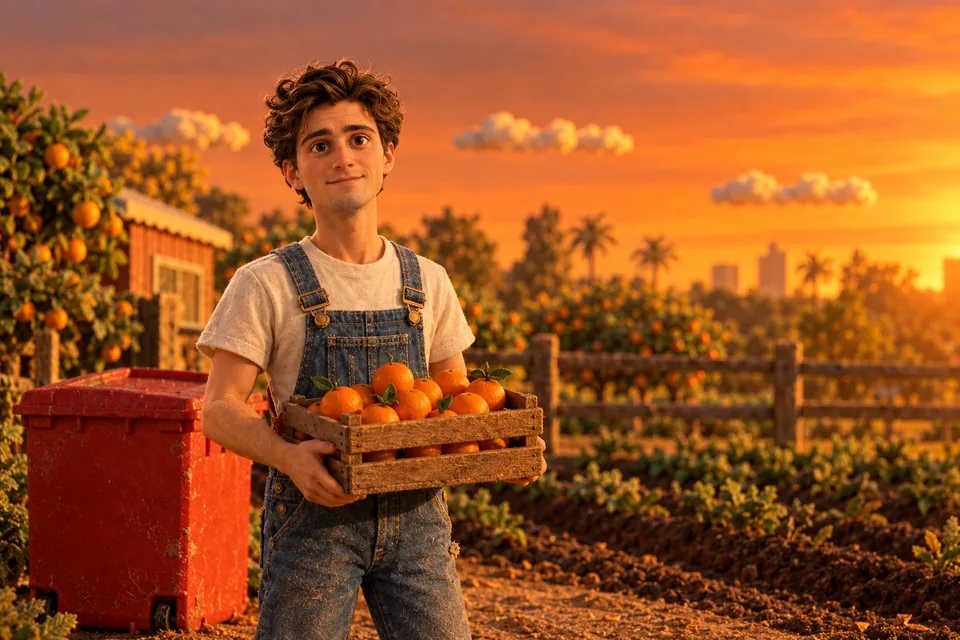
No loose ends. If we start it, we finish it.
Ethan Babil, Director
02 / What I believe
What I believe.
Waste is a beginning.
Nothing we throw away is the end of the story. It’s soil, then food, then the next meal.
One loop at a time.
Close one loop. Then the next one. That’s how a city changes.
Everyone’s part of it.
Everyone makes waste, which means everyone can be part of the fix.
03 / Circularity in Miami
Circularity in Miami.
The West Coast proved the model: the jobs, the food kept out of landfill, the farms it feeds. Miami is next. One of the fastest growing cities in America, built on a healthy, active lifestyle, and missing one piece: food grown close to home, in soil made from our own scraps.