
What Is the Loop? How Food Scraps Become Local Food
Food scraps don't have to end in a landfill. Here is how the loop turns kitchen waste into compost, compost into crops, and crops back into dinner in Miami-Dade.
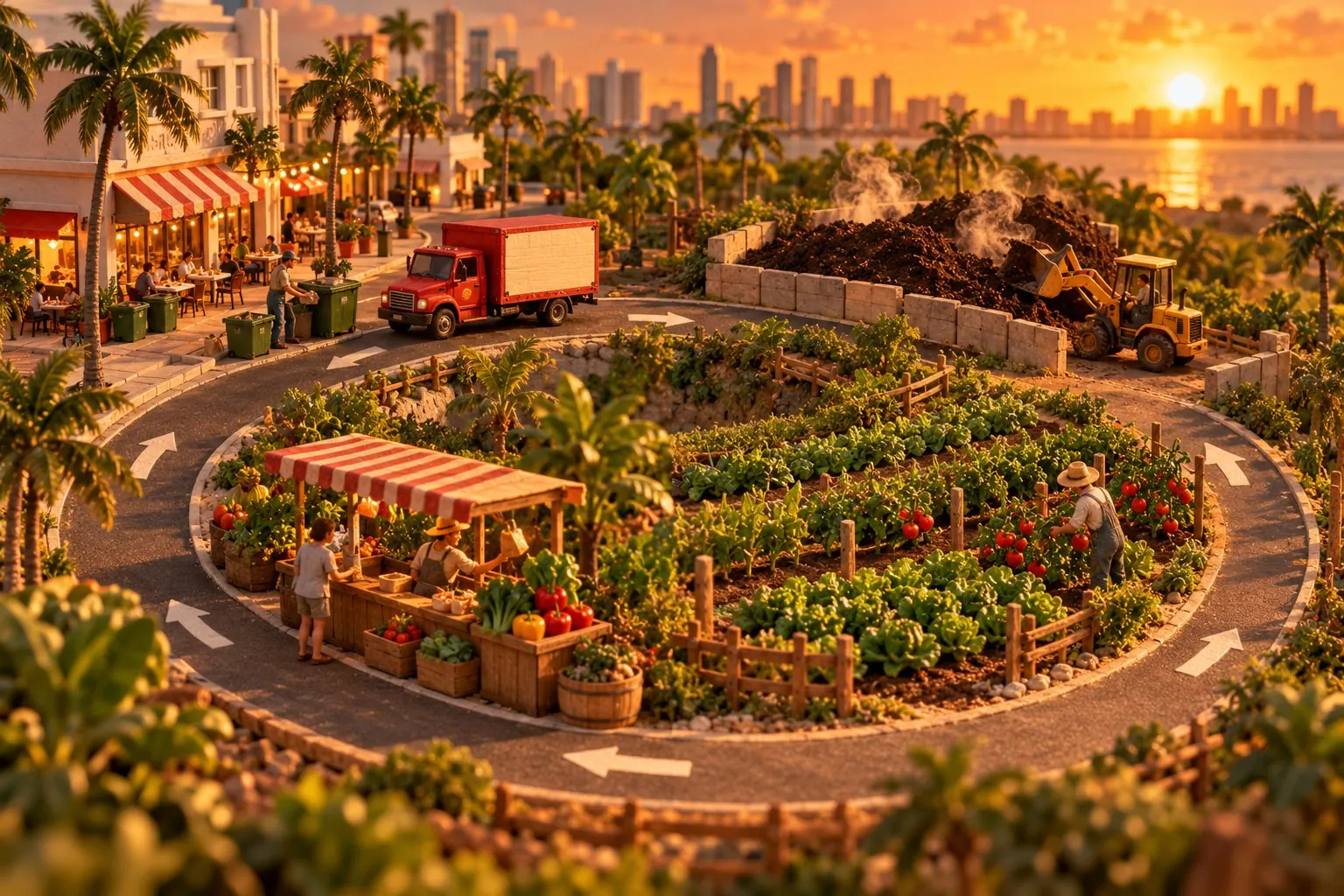
The loop is a circular food system: food scraps get collected, hot-composted into rich soil, and that soil goes back to local farms to grow the next round of food. Nothing ends in a landfill. Scraps from a Miami kitchen become the compost under next season's tomatoes, and those tomatoes come back to the same kitchens.
What is a circular food system?
Most food moves in a straight line. A farm grows it. A truck moves it. A kitchen cooks it. Somebody eats most of it. The rest goes in the trash, and the trash goes to a landfill. End of story.
A circular food system bends that line into a loop. The part we used to call waste becomes the start of the next harvest. Peels, trimmings, plate scrapings, coffee grounds, stale bread, bones: all of it gets collected and turned into compost. Compost goes into farm soil. Better soil grows food. Food goes back to the kitchen.
That's it. No magic. It's how farms worked for a long time before we got good at throwing things away. The difference now is scale. A city makes a lot of scraps, and somebody has to pick them up on a schedule, process them properly, and get the finished compost to the people who grow food.
That's the job Melly's was built to do. We named the company after my mom, Melissa, and her rule was simple: you finish what you started. Food is the same. If a farm starts it, somebody should finish it. The loop is how you finish it.
If you want the ground-level version of what happens inside a compost pile, start with what composting actually is.
How much food actually gets wasted?
More than most people guess. The USDA estimates that food waste in the United States runs 30 to 40 percent of the food supply (USDA). That is food that got grown, watered, harvested, packed, shipped and cooled, and then didn't get eaten.
Some of that waste can be prevented. Better ordering, smarter prep, donating what's still good. That should always come first, and the EPA ranks prevention and donation at the top of its Wasted Food Scale. Landfill sits at the bottom.
But every kitchen still makes scraps. You can't eat an onion skin or a chicken bone or the grounds out of the espresso machine. The real question is where those go. Right now, for most of the country, the answer is the landfill. EPA's data for 2019 estimates that about 66 million tons of wasted food came out of retail, food service and homes, and about 60 percent of it was sent to landfills (EPA).
The loop is about changing that one decision. Not the whole food system. Just where the scraps go.
Why does food in a landfill cause problems?
Because a landfill is the wrong place for food to rot.
When food breaks down in open air, with oxygen, microbes turn it into compost, carbon dioxide and water. When food gets buried under tons of other trash with no oxygen, a different set of microbes takes over and makes methane. Methane is a greenhouse gas the EPA rates at 28 times the warming impact of carbon dioxide over 100 years (EPA).
Here is what the numbers look like:
- Food made up about 24 percent of everything landfilled in 2018, more than any other single material (EPA).
- Municipal solid waste landfills are the third-largest source of human-related methane in the United States (EPA).
- EPA estimates that 58 percent of the methane that escapes from those landfills comes from food waste (EPA).
- And about 61 percent of the methane made by landfilled food isn't captured by gas collection systems, because food rots fast, often before collection gets installed (EPA).
So food is the material that rots fastest, makes the most landfill methane, and is hardest to catch. It's also the easiest to pull out. You don't need new technology. You need a separate bin and a truck that shows up.
How do food scraps become local food?
Here is the loop, start to finish, the way we run it.
- The kitchen sorts. Scraps go in a red 64-gallon bin instead of the dumpster. Meat, bones and dairy go in too. One bin size, so nobody has to think about which bin is which.
- The truck picks up. We come 1 to 3 times a week depending on volume, never less than weekly, so nothing sits long enough to turn into a problem. Every pickup, we swap in a clean bin.
- The scraps get hot-composted. At our yard, scraps get mixed with carbon material like wood chips and built into piles. Microbes go to work and the pile heats up. We run it to EPA standards: 131 F or higher for the required time, which is the temperature that knocks out pathogens and weed seeds. That standard comes from the federal rule for treating organic material, which spells out the time at temperature for each composting method (eCFR via Cornell LII).
- The compost cures. After the hot phase, the pile slows down, cools and finishes. What comes out is dark, crumbly and smells like a forest floor.
- Farms put it in the ground. We sell finished compost wholesale by the cubic yard. Growers pick it up at our yard by appointment (delivery is coming soon), and it goes into beds, orchards and nurseries.
- Food comes back. Those farms grow vegetables, fruit and plants that end up at markets, stands and restaurants. Some of those restaurants are the same ones that filled the bin.
Then it starts again. That's why we call it the loop. If you want to see what's growing locally right now, look at the farms on our find local farms page.
For a closer look at why the heat matters so much, read hot composting, explained.
What does compost actually do for soil?
Compost is mostly organic matter, the stuff that makes soil act like soil instead of sand or rock. Organic matter holds water like a sponge. It feeds the microbes and fungi that help roots pull in nutrients. It gives soil structure so roots can push through and air can get in.
Fertilizer feeds plants. Compost feeds soil. Most growers use both, and they work well together. Compost doesn't replace a good fertility program. It makes the ground hold onto more of what you put in it.
There's a nice symmetry in that. The nutrients in a banana peel came out of some farm's soil in the first place. Composting it returns that material to soil instead of burying it where nobody can use it.
Why does a circular food system make business sense?
I'm going to be straight about this. Melly's is a business. We want to grow, we want to make money, and we want our customers to make money too. The loop only works if it pays for everyone in it.
Here's how it pays:
- For kitchens and buildings: food scraps are heavy and wet. Pulling them out of the dumpster can mean fewer or smaller trash pickups. Pricing depends on volume, which is why we start with a free waste audit and a straight quote. Month-to-month, so you're not locked in.
- For farms: good compost made close to home, from local scraps, sold by the cubic yard. Less hauling from far away and soil that holds more water and nutrients.
- For the area: fewer tons heading to landfill, more local food, and jobs that stay here.
A loop that only works on good intentions doesn't last. A loop that saves a restaurant some hassle and gives a grower better soil keeps running because people want it to.
How does the loop work in Miami-Dade and South Florida?
Miami-Dade is a good place for the loop, and a place that needs it.
The heat. Food rots fast in South Florida. A dumpster full of scraps in August is not something anyone wants to stand next to. That's one reason we never go less than weekly and why we swap in a clean bin every pickup. Fast-moving scraps are clean scraps.
The soil. South Florida soil is sandy in a lot of places and rocky limestone in others, especially down in the Redland. UF/IFAS notes that subtropical soils typically have about 1 percent organic matter or less, and that year-round microbial activity burns through what's there, which is why they recommend adding compost every year (UF/IFAS Extension). Our growers need organic matter more than most. Our kitchens throw it away every day. The loop connects the two.
Hospitality. This is a restaurant, hotel and events town. That means a steady stream of food scraps, and it means a lot of businesses with a reason to care about what happens to them.
Local goals. Miami-Dade County has a Zero Waste Master Plan with 31 strategies, and organic waste processing and composting is one of its key focus areas. The long-term target is to divert 90 percent or more of solid waste from disposal (Miami-Dade County). Florida also has a statewide recycling goal of 75 percent, set in state law (Florida DEP). Food is a big piece of the waste stream, so food scraps are a big piece of hitting those numbers.
Local farms. Miami-Dade still has real working farmland, from winter vegetables to tropical fruit to nurseries. Keeping those farms strong keeps fresh food close. More on that in why local farming matters in Miami.
Who can join the loop?
Anyone who makes food scraps or grows food.
- Restaurants and cafes. Prep scraps, plate waste, coffee grounds.
- Hotels and resorts. Kitchens, buffets, banquets.
- Apartment and condo buildings. Residents' kitchen scraps in a shared bin.
- Schools, offices and venues. Cafeterias, break rooms, events.
- Grocers and markets. Produce that's past selling.
- Farms and nurseries. The other end of the loop, buying compost by the cubic yard.
If you're on the scraps side, get a quote and we'll start with a free waste audit. If you're on the growing side, get wholesale pricing for compost.
Frequently asked questions
What is the loop in simple terms?
The loop is a circular food system. Food scraps get picked up, composted, and the compost goes back to farms to grow more food. Nothing goes to a landfill.
Is a circular food system the same as composting?
Composting is one step inside it. The circular food system is the whole cycle: collection, composting, using that compost on farms, and the food coming back to the community. Composting without the farm side is only half a loop.
Can meat, bones and dairy go in the loop?
Yes. Hot composting at commercial scale handles meat, bones and dairy, which most backyard piles can't. That's why we accept them in our bins.
How often do you pick up in Miami-Dade?
One to three times a week, based on how much you make. Never less than weekly, because food doesn't wait in this heat. We swap in a clean bin every pickup.
Do I need to sign a long contract?
No. Service is month-to-month. We start with a free waste audit so the schedule fits your volume from day one.
Ready to close the loop? Businesses, get a quote and we'll start with a free waste audit. Growers, get wholesale pricing on compost by the cubic yard. Either way, your scraps stop being trash and start being food again.
Sources
- USDA: Food Waste FAQs
- EPA: Food, Material-Specific Data
- EPA: Quantifying Methane Emissions from Landfilled Food Waste
- EPA: Basic Information about Landfill Gas
- EPA: Methane Emissions
- EPA: Wasted Food Scale
- Cornell LII: 40 CFR Appendix B to Part 503, Pathogen Treatment Processes
- UF/IFAS Extension Sarasota County: How to Use Compost
- Miami-Dade County: Zero Waste Master Plan
- Florida DEP: Florida's 75% Recycling Goal
Related posts
-
 For everyone
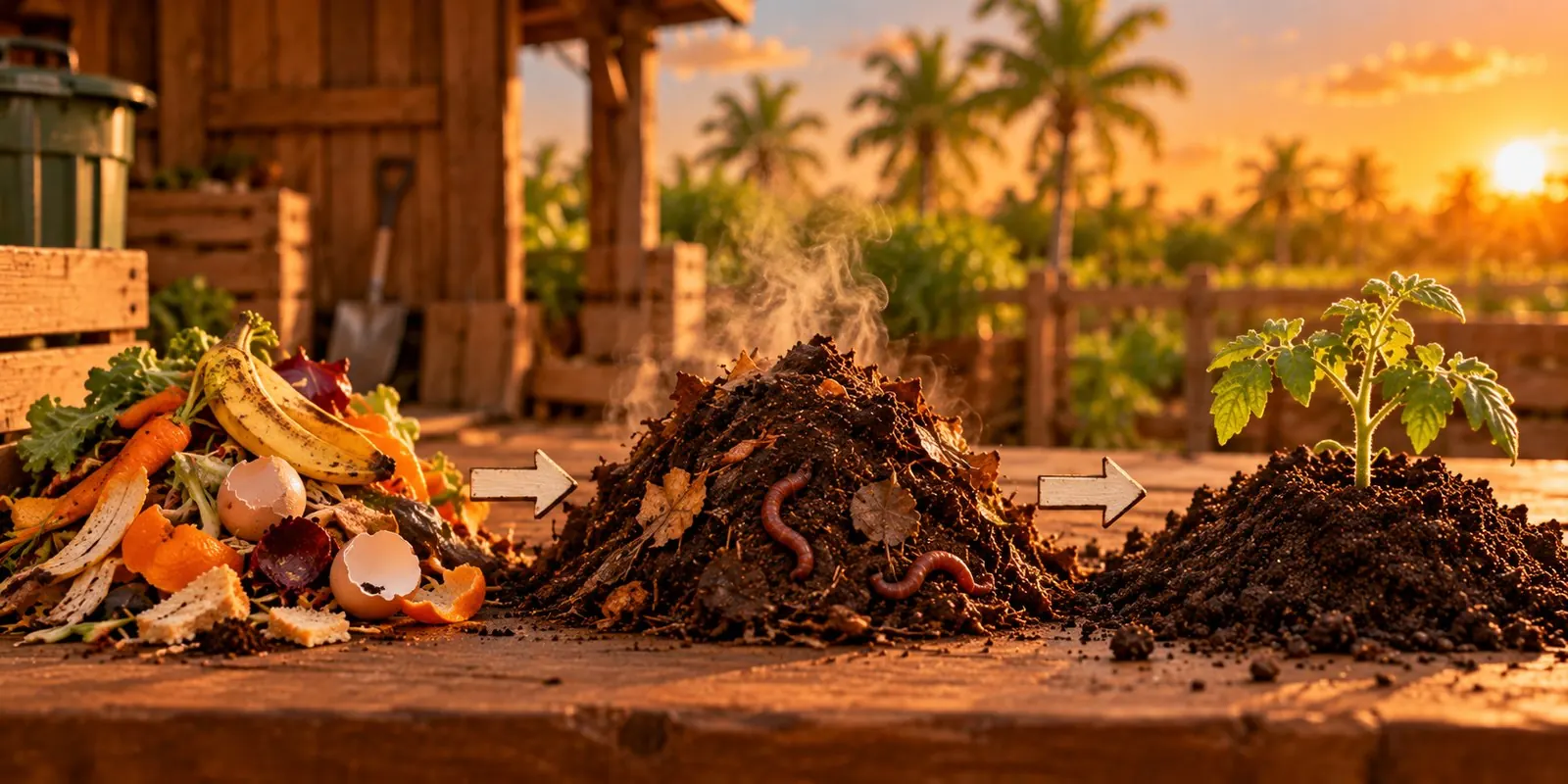
What Is Composting?
Composting is controlled rotting. Microbes, air and water turn scraps into dark, crumbly soil. Here is how it works and why it matters.
-
 For everyone
Why Local Farming Matters in Miami
Miami-Dade still farms, and it grows things almost nobody else in the country can. Here is why that matters, what is putting pressure on it, and how a food scrap can help.