
Compost for South Florida Farms: The Grower's Guide
Sandy ground, rock-plowed limestone, hard sun. Here is how compost earns its place on a South Florida farm, how much to use, and how to buy it by the yard.
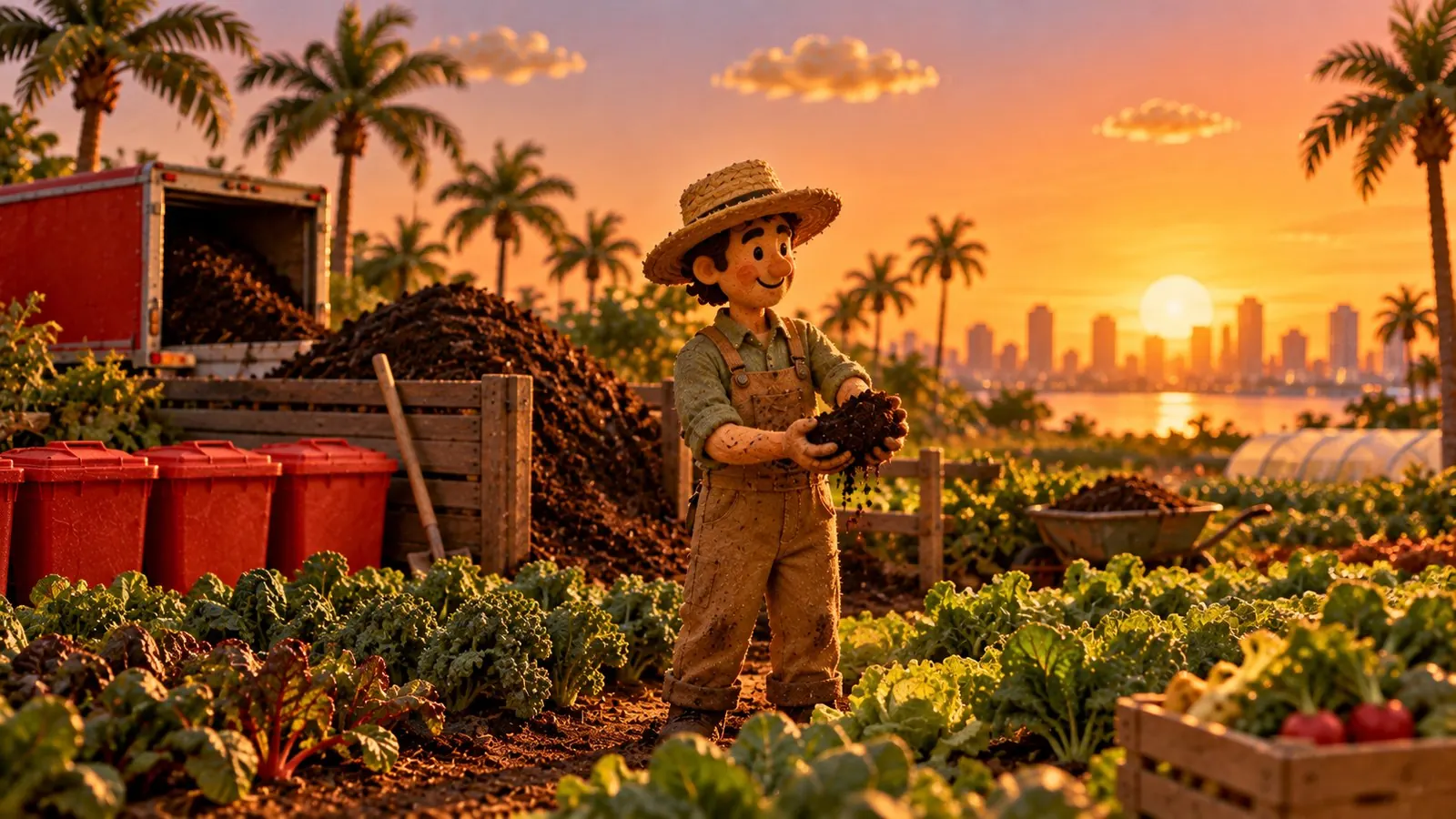
Compost is the most direct way to give South Florida ground what it is missing most: organic matter. Spread on sand or rock-plowed limestone, good finished compost helps the soil hold water and nutrients, feeds the life underground, and makes your fertilizer work harder. Use it alongside a soil test and a fertilizer plan, not instead of one.
Why do Florida farms need compost?
Because the ground does not hold on to much. UF/IFAS Extension describes Florida soils as naturally sandy and extremely low in organic material, which means water and nutrients leach out fast (UF/IFAS Pasco County Extension). You irrigate, and it drains. You fertilize, and a good share of it washes past the roots.
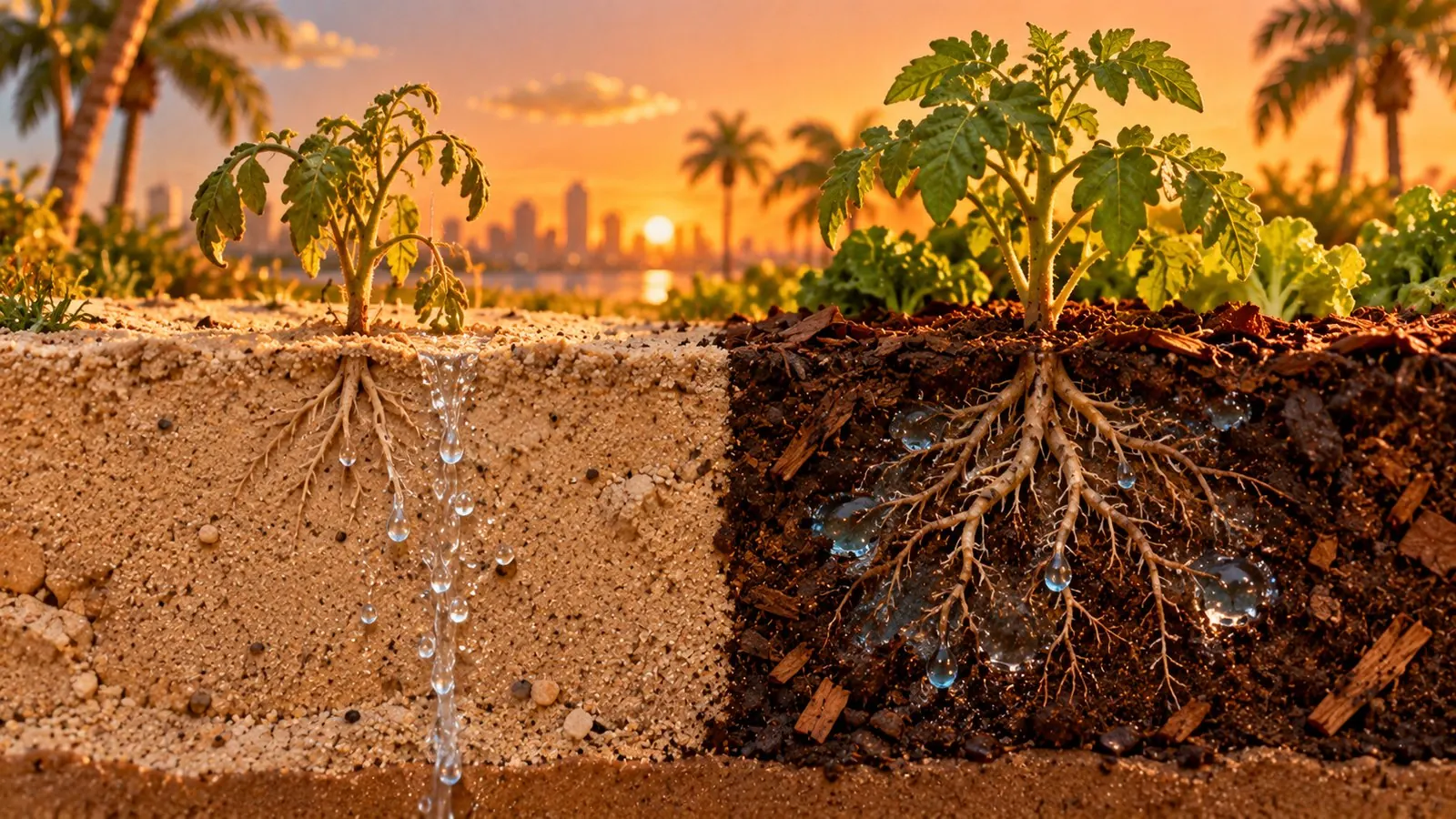
Organic matter is the fix for that. It acts like a sponge in the soil. A UF/IFAS study tested sandy soil and calcareous limerock soil and found that every 1% increase in organic matter raised water holding capacity by 2.3% in the sand and 1.3% in the limerock (UF/IFAS Extension). The same publication cites USDA NRCS estimates that each 1% gain in organic matter can help soil hold up to 20,000 more gallons of water per acre. NRDC's soil team checked that number and found it holds only under certain assumptions, so treat it as an upper end, not a promise (NRDC).
Either way, the direction is the same. More organic matter, more water and nutrients stay where the roots can reach them. For the full picture on sand, read how compost fixes sandy Florida soil.
What does compost actually do for the soil?
Compost is not just a nutrient. It is a soil builder. The US EPA lists what compost does when it goes into the ground: it improves soil structure, helps soil hold water, slowly releases nutrients, supports higher populations of beneficial soil organisms, and stores carbon in the soil (US EPA).
On a working farm, that looks like this:
- Water. Beds stay moist longer between irrigation sets.
- Nutrients. Compost carries nitrogen, phosphorus, potassium and micronutrients, and it releases them slowly instead of all at once.
- Structure. In sand, it binds loose grains. In rocky ground, it fills the gaps between stone.
- Life. Microbes, fungi and worms need carbon to eat. Compost is carbon.
The slow release part matters. UF/IFAS works through an example for tomatoes: 10 tons of compost at 60% dry matter and 3% nitrogen, with 10% of that nitrogen becoming available, gives you about 36 pounds of available nitrogen per acre. Against a crop that needs 200 pounds, the rest still has to come from fertilizer (UF/IFAS). That is not a knock on compost. It is the reason compost and fertilizer belong together.
How much compost should you put on a farm?
Start with the math, then let the soil test decide.
An acre is 43,560 square feet. One inch deep across that acre is 3,630 cubic feet, which is about 134 cubic yards. Caltrans uses the same figure, about 135 cubic yards per acre per inch, in its erosion control guidance (Caltrans). So:
- A quarter inch is roughly 34 cubic yards per acre.
- A half inch is roughly 67 cubic yards per acre.
- A full inch is roughly 134 cubic yards per acre.
Weight depends on moisture and what the compost was made from, so always ask for the bulk density on the lab report if you are planning in tons. When you see a rate in tons, UF/IFAS warns you to check whether it is wet weight or dry weight, because compost can carry a lot of water.
Most growers do not dump an inch every season. A heavier first application to build up a tired field, then lighter maintenance passes, is a common pattern. The right number for your ground depends on your crop, your soil test and what the compost brings. We walk through the numbers step by step in how much compost per acre.
When and how should you apply compost?
Timing in South Florida follows the season. Most vegetables here go in during the cooler, drier months, so the window for spreading is late summer into fall, before beds are formed and plastic goes down. That gives the compost time to settle into the soil before transplants.
A few ways farms use it:
- Broadcast and incorporate. Spread across the field, then disc or till it into the top few inches before bedding.
- In the bed. Band compost where the bed will sit, so every yard ends up under the crop instead of in the row middles.
- Topdress trees. For avocado, mango, lychee and citrus, spread it under the canopy out to the drip line and keep it a few inches off the trunk.
- Transplant and potting mixes. Blend it with peat or bark for starts. UF/IFAS found seedlings did as well as in traditional peat and vermiculite media when part of the peat was replaced with compost, but pure compost hurt growth, especially when the compost was not mature (UF/IFAS).
One more thing. Keep finished compost covered or use it soon after delivery. A pile sitting out through a summer of afternoon storms loses some of what you paid for.
How do you know if compost is good quality?
Look, smell, then read the paperwork.
Good finished compost is dark, crumbly and smells like a forest floor. It should not smell sour or like ammonia, and you should not be able to pick out what it used to be. If you can still see lettuce leaves, it is not done.
Then ask for a lab analysis. The things that matter most for a farm:
- Maturity and stability. Immature compost can tie up nitrogen and stunt plants.
- Carbon to nitrogen ratio. Clemson University's agricultural lab gives 10:1 to 15:1 as the reference range for finished compost (Clemson University). A ratio far above that means the compost may borrow nitrogen from your soil.
- Soluble salts and pH. These matter most for transplants and containers.
- Pathogen reduction. For windrow composting, the federal pathogen standard in 40 CFR Part 503 calls for 55 degrees C (131 F) or higher for 15 days or longer, with at least five turnings during that time (Cornell LII, 40 CFR Part 503 Appendix B).
Our compost is hot-composted to EPA standards: 131 F or higher for the required time. Ask us for our most recent lab results before you buy.
Can compost replace fertilizer?
No, and you should be wary of anyone who says it can. Compost releases nutrients slowly, and only part of its nitrogen becomes available in the first season, as the UF/IFAS example above shows. UF/IFAS also notes that compost combined with inorganic fertilizer generally works better than either one alone (UF/IFAS).
Think of it this way. Fertilizer feeds this crop. Compost builds the ground that feeds every crop after it. Over a few seasons, as organic matter climbs, you may find your soil tests asking for less. That is a decision you make with your soil test and your extension agent, not a guess.
Compost in Miami-Dade and the Redland
Farming down here is not like farming anywhere else in the country, and the soil is the biggest reason.
Much of the Redland and Homestead farm belt sits on Krome soils. USDA's official soil description says Krome occurs only in Dade County, that it is very shallow soil over limestone, and that tomatoes, beans, avocados and limes are its main crops (USDA NRCS). UF/IFAS reports that most of these gravelly soils are rock-plowed on a regular basis, which creates 6 to 12 inches of soil above the bedrock (UF/IFAS Extension). Six inches of crushed rock is not a lot of room for roots, water or nutrients.
That rock is limestone, and it changes the chemistry. UF/IFAS says calcareous soils in Miami-Dade are derived from Miami limestone, usually contain 30% to 94% calcium carbonate, and typically run a pH of 7.4 to 8.4. Iron chlorosis is the most frequent nutritional disorder in crops grown on them, and potassium leaches readily from sandy or gravelly soils (UF/IFAS Extension). The Miami-Dade Extension office has a good plain overview of how these soils formed (UF/IFAS Extension Miami-Dade).
Compost will not turn limestone into loam. What it does is add the organic matter that rock-plowed ground almost entirely lacks, so the thin layer you have holds more water and feeds more life. We go deeper on that in compost for rocky and limestone soils.
The farms here are mostly small, too. The 2022 Census of Agriculture counted 2,664 farms in Miami-Dade County on 68,837 acres, an average of 26 acres each, and the county ranks first in Florida for sales of nursery, greenhouse, floriculture and sod (USDA NASS). Small farms and nurseries do not need a trainload. They need a local source that sells by the cubic yard. If you run containers, see compost for nurseries and potting mixes.
Then there is the heat. High temperatures and heavy rain speed up how fast soil life burns through organic matter, so building it up in South Florida is a steady job, not a one-time fix. That is the case for regular, moderate applications over big one-off dumps.
Where does Melly's compost come from, and how do you buy it?
Ours starts in Miami-Dade kitchens. We pick up food scraps from restaurants, hotels and other businesses in red 64-gallon bins, 1 to 3 times a week, and hot-compost them to EPA standards: 131 F or higher for the required time. Meat, bones and dairy go in too, because a hot process can handle them. Then it cures, gets screened, and comes back to local ground.
We sell it wholesale by the cubic yard. Right now it is pickup at our yard by appointment, and delivery is coming soon. Pricing depends on volume, so ask for wholesale pricing and we will get back to you. If you have never bought bulk compost before, read how to buy compost in bulk first. It covers trucks, loaders, what to check on arrival and how to plan your order.
Frequently asked questions
Is compost good for Florida sandy soil?
Yes. Sandy Florida soil is low in organic matter, and compost adds it, which helps the soil hold more water and nutrients. UF/IFAS research found water holding capacity in sand climbed with every percent of organic matter added.
How much compost do I need per acre?
One inch across an acre is about 134 cubic yards, a quarter inch is about 34. Most farms use moderate rates and repeat them, and a soil test plus a compost lab analysis should set your number.
Can I use compost on vegetables I will sell?
Yes, when the compost is finished and was made with a process that reaches pathogen-killing temperatures. For windrows, the federal standard is 131 F or higher for at least 15 days with five turnings. Ask your supplier how their process meets that, and follow any food safety rules your buyers or programs require.
When should I spread compost in South Florida?
Before your main planting, which for most vegetables here means late summer into fall, before beds are formed. Tree crops can take a topdressing at almost any time, ideally ahead of the rainy season so the rain carries it in.
Does Melly's deliver compost?
Not yet. Right now our compost is pickup at our yard by appointment, sold wholesale by the cubic yard. Delivery is coming soon.
If you farm, grow or run a nursery in South Florida and want local compost made from Miami-Dade food scraps, get wholesale pricing and tell us your acreage and timing. We will come back with volume pricing and a pickup window at our yard. You can see what we make and how it is handled on our soil page.
Sources
- USDA NASS: 2022 Census of Agriculture County Profile, Miami-Dade County
- UF/IFAS Extension: Raising Soil Organic Matter Content to Improve Water Holding Capacity
- UF/IFAS Pasco County Extension: Soil Amendments, Why are they important?
- NRDC: Organic Matter Can Improve Your Soil's Water Holding Capacity
- US EPA: Benefits of Using Compost
- UF/IFAS: Compost and manure use in vegetable production
- Caltrans: Erosion Control Toolbox, Compost
- Clemson University Agricultural Service Laboratory: Compost Interpretations
- Cornell LII: 40 CFR Appendix B to Part 503, Pathogen Treatment Processes
- USDA NRCS: Krome Series Official Soil Description
- UF/IFAS Extension: Tomato production in Miami-Dade County
- UF/IFAS Extension: Calcareous Soils in Miami-Dade County
- UF/IFAS Extension Miami-Dade: South Florida Soils
Related posts
-
 For farmers
How Compost Fixes Sandy Florida Soil
Florida sand lets water and fertilizer run straight through. Compost gives it something to hold on with. Here is how, and how much to use.
-
 For farmers
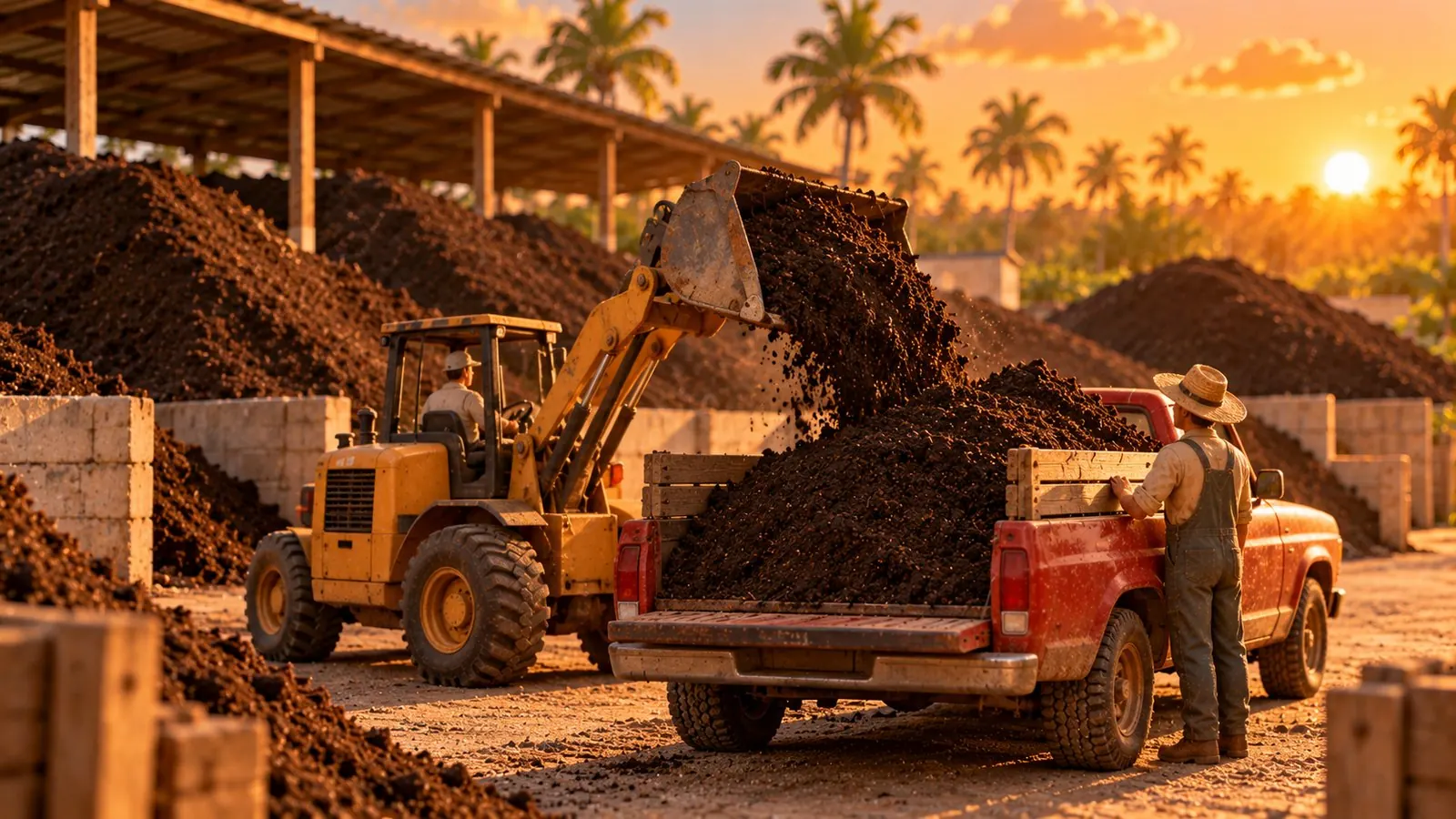
How to Buy Compost in Bulk
Buying compost by the yard is simple once you know four things: how much you need, what is in it, how it was made, and how it gets to your field.