
Hotel Food Waste: A Composting Playbook
Buffets, banquets, room service and the staff cafeteria. A hotel has several kitchens under one roof. Here is how to get all of them composting without slowing anybody down.

The best way for a hotel to handle food waste is to measure it outlet by outlet, cut what you can at the source, donate safe surplus food, and compost everything else with a hauler who picks up often enough for Miami heat. Hotels make food waste in more places than a restaurant does, so the trick is a bin at every point where scraps happen and one person who owns the whole program.
Where does hotel food waste come from?
More places than people think. Walk a full-service hotel at the end of a day and you'll find it in:
- Banquets and catering. Overproduction is built in, because nobody wants to run out at a wedding.
- Breakfast buffets. Trays pulled at close, plus plate waste from guests.
- Restaurant and bar outlets. Prep trimmings and plate scrapings, same as any restaurant.
- Room service. Trays come back with half the plate still on them.
- The employee cafeteria. Often forgotten and often one of the steadiest sources.
- Stewarding and the dish room. Where it all ends up.
Each one needs its own bin placement and its own habit. A hotel program that only covers the main kitchen is missing half the scraps.
How do hotels measure food waste?
Measurement first. You can't fix what you can't see.
World Wildlife Fund and the American Hotel and Lodging Association, with support from The Rockefeller Foundation, built a free toolkit called Hotel Kitchen for exactly this. In their 12-week pilot with 10 hotels, properties cut food waste by at least 10 percent by measuring it and getting staff engaged. The properties with the most engaged owners, general managers and executive staff did best.
A simple version for any hotel:
- Pick one week. Weigh or count bins of food waste at each outlet.
- Note why. Overproduction, spoilage, trim, plate waste.
- Share it. Post the numbers in the kitchen. Cooks are competitive.
- Repeat monthly. Watch it move.
Melly's starts with a free waste audit that covers every outlet, so you get a map of where the scraps actually come from.
How do you set up composting in a hotel?
Once you know where the waste is, setup is straightforward.
- A bin at every source. Prep lines, the dish room, banquet breakdown, buffet teardown, the employee cafeteria. Melly's uses one bin size, 64 gallons, red with a lid. You get as many as each area needs.
- One collection point. Bins roll to the loading dock or service entrance on pickup day. Nothing goes through guest areas.
- Pickups 1 to 3 times a week. Never less than weekly. Big banquet weekends may need more, and month-to-month service lets you add pickups when the calendar fills up.
- Clean bins every time. We take the full bins and leave clean ones. Your stewards don't wash compost bins.
- One owner. Usually the executive chef, the director of stewarding, or a sustainability lead. Someone who knows pickup day and checks the bins.
Everything that was food goes in, including meat, bones, seafood and dairy, because we hot-compost to EPA standards (131 F or higher for the required time). Packaging, gloves, portion cups and plastic wrap stay out.
How do you train hotel staff to sort food scraps?
Hotels have more people touching food than most restaurants, and more turnover. Keep it simple and repeatable.
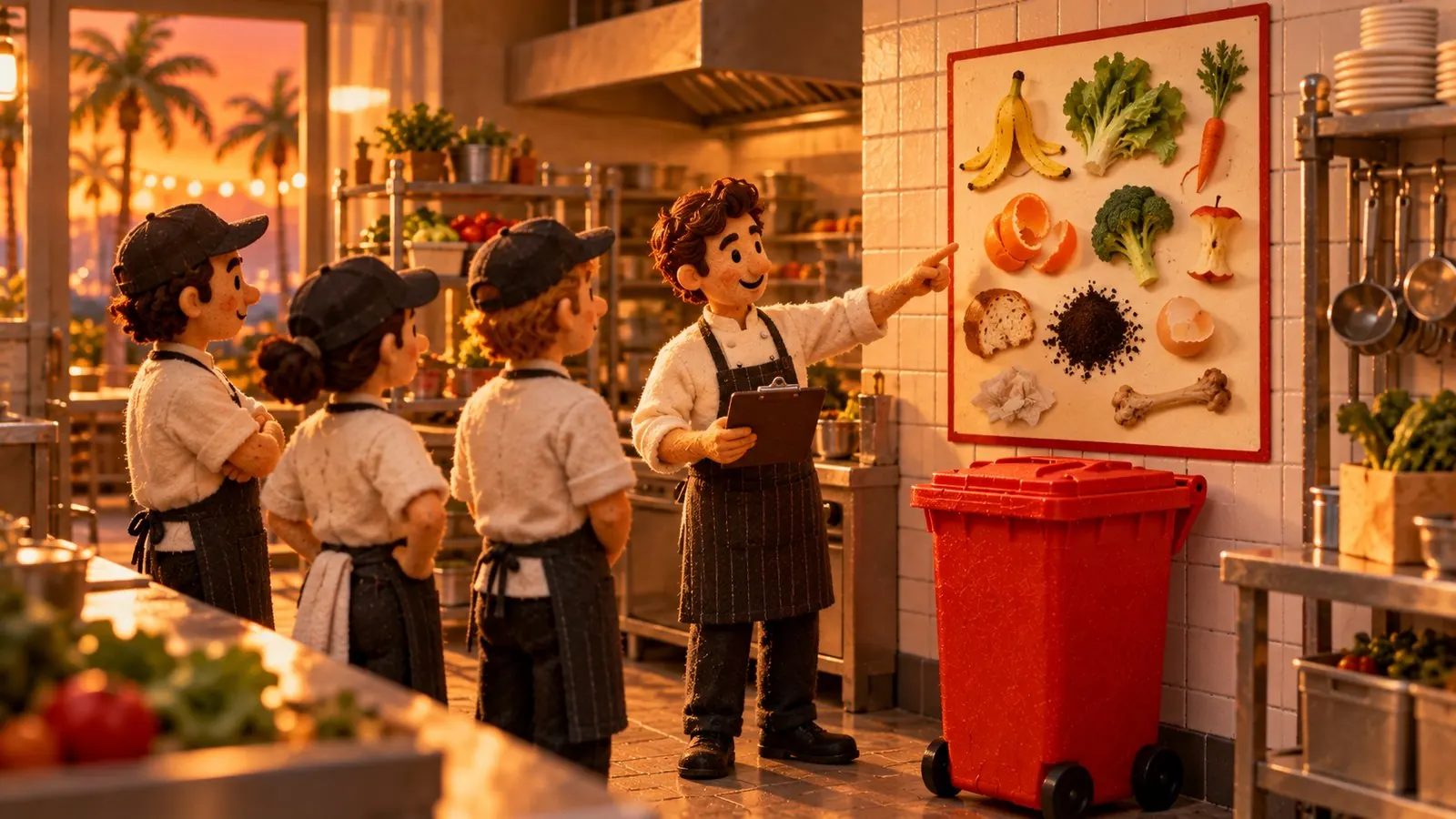
- One rule everywhere. Food goes in the red bin. Same rule in banquets, the outlets and the cafeteria.
- Add it to onboarding. A new banquet server should hear it on day one.
- Pre-shift reminders. Thirty seconds, especially before big events.
- Check the bins. Gloves and plastic wrap are the usual problems. Fix it calmly and fast.
For a step-by-step version you can use with any kitchen team, read how to train kitchen staff to sort food scraps. Banquet teams work a lot like event crews, so event and stadium composting in Miami has useful ideas too.
Should hotels donate food before composting it?
Yes, when it's safe. The EPA's Wasted Food Scale ranks the options for food that would otherwise go to waste. Preventing waste comes first, then donating food people can still eat, then composting. Landfill is at the bottom.
So the order for a hotel is:
- Prevent. Tighter banquet counts, smaller buffet trays refilled more often, menus that use trim.
- Donate. Unserved food that's been held safely can often go to a local food recovery group.
- Compost. Everything that can't be eaten: trim, plate waste, spoiled product.
Composting covers what's left. It should never be an excuse to overproduce.
Hotel food waste in Miami-Dade: what's different?
Volume. Miami-Dade drew more than 28 million visitors in 2024, according to the Greater Miami Convention and Visitors Bureau, and the county led Florida in hotel occupancy that year. Full hotels mean full kitchens and full bins.
Season. Winter season, big conventions and event weekends can swing a hotel's food waste up and down fast. Month-to-month pickups that you can adjust matter here.
Heat and humidity. Food waste at a loading dock in August turns quickly. Lidded bins, swapped clean at every pickup, at least weekly, keep the service entrance from smelling like a dumpster.
Guests notice. A beachfront resort can't have flies at the service entrance. Taking food out of the dumpster helps.
The county's direction. Miami-Dade's Zero Waste Master Plan is aimed at diverting far more waste from landfill by 2040, and organics are part of it. Hotels are some of the biggest food waste producers in the county, which puts them right in the middle of that conversation. For the full local picture, start with our guide to commercial composting in Miami.
Frequently asked questions
How often should hotel food waste be picked up?
At least weekly, and usually 2 to 3 times a week for a full-service hotel with banquets. Melly's picks up 1 to 3 times a week and swaps in clean bins every time. You can add pickups for big event weekends.
Can hotels compost meat, seafood and dairy?
Yes. Melly's hot-composts to EPA standards, 131 F or higher for the required time, so meat, bones, seafood, dairy and eggs all go in. Packaging stays out.
How much does hotel composting cost?
It depends on your volume and pickup schedule. We start with a free waste audit across every outlet and give you a quote. Service is month-to-month.
What about compostable to-go containers and cups?
Ask us before you buy. Some compostable products break down well in a pile and some don't. We'll tell you what works so you don't pay for packaging that ends up as contamination.
Ready to get your hotel's kitchens composting? We'll do a free waste audit across every outlet, place the bins, and set a pickup schedule that fits your calendar. Get a quote and we'll set it up.
Sources
- World Wildlife Fund: Hotel Kitchen, Fighting Food Waste in Hotels
- Hotel Management: American Hotel and Lodging Association shares food waste project results, hotel toolkit
- U.S. EPA: Wasted Food Scale
- U.S. EPA: Approaches to Composting
- Greater Miami Convention and Visitors Bureau: State of the Travel and Tourism Industry, May 29, 2025
- Hotel Online: Greater Miami Convention and Visitors Bureau report, record number of visitors in 2024
- Miami-Dade County: Zero Waste Master Plan
Related posts
-
 For businesses
Event and Stadium Composting in Miami
A festival can fill a dumpster with food in one night. Here is how Miami venues and event teams keep it out of the landfill.
-
 For businesses
How to Train Kitchen Staff to Sort Food Scraps
Your crew is slammed, multilingual and turning over. Here is how to get clean food scraps anyway.