
Compost vs. Synthetic Fertilizer
Fertilizer feeds the crop. Compost feeds the ground the crop lives in. Most good farms use both, and on sandy Florida soil the combination matters more than ever.
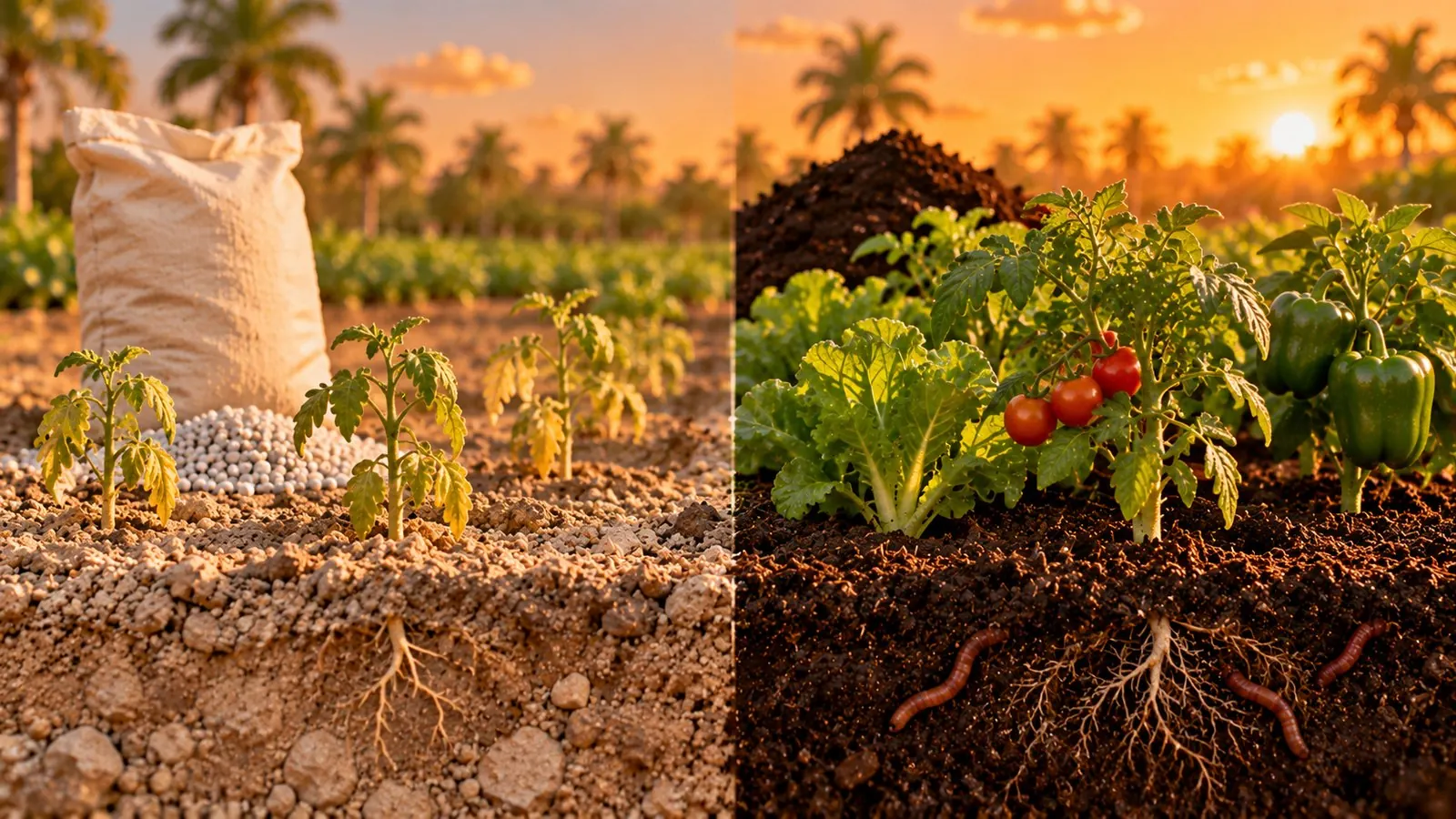
Compost and synthetic fertilizer do different jobs. Fertilizer delivers specific nutrients fast, right when a crop needs them. Compost builds the soil itself, adding organic matter that holds water and nutrients, so most farms get the best results using both.
What is the difference between compost and fertilizer?
Fertilizer is a product made to deliver nutrients. A bag tells you exactly how much nitrogen, phosphorus and potassium is inside, and most of it is available to the plant quickly. That precision is why growers rely on it. When a crop needs nitrogen at a certain stage, fertilizer gets it there.
Compost is decomposed organic material: in our case, food scraps from Miami-Dade kitchens, hot-composted and cured. It carries nutrients too, but in smaller amounts and in forms that release slowly as soil life breaks it down. What compost really brings is organic matter. That organic matter changes how your soil behaves.
Think of it this way. Fertilizer is the meal. Compost is the kitchen. A good kitchen does not cook for you, but everything you cook comes out better.
Is compost better than fertilizer?
Better at what? That is the real question.
If your crop is short on nitrogen next week, fertilizer wins. Compost will not fix a nutrient deficiency on a deadline. Its nutrients come out slowly, and a compost that is not fully finished can even tie up nitrogen while it keeps breaking down.
If your soil drains like a colander, dries out two days after a rain and loses nutrients every time it pours, compost wins. Fertilizer cannot add structure. According to the EPA, compost enhances water retention in soils and reduces, and in some cases eliminates, the need for chemical fertilizers.
So it is not either or. Use each for what it does best.
Can compost replace synthetic fertilizer?
Sometimes, partly. On some crops and some soils, steady compost use builds enough fertility that growers cut back their fertilizer. On heavy feeders, or during fast growth stages, most growers still need targeted nutrients.
Compost nutrient numbers on a lab report are not a guaranteed analysis. Technical data sheets usually say so right on the page. That means you cannot swap a bag of fertilizer for a yard of compost one to one and expect the same result. Start with a soil test, figure out what the crop needs, then decide how much compost and how much fertilizer gets you there. For the compost side of that math, see how much compost per acre.
How does compost help fertilizer work better?
This is where the two become partners. Organic matter holds on to nutrients and water. When fertilizer goes into soil with more organic matter, more of it stays where roots can reach it.
UF/IFAS researchers point out that on Florida's sandy soils, low water and nutrient holding capacity and heavy rain make fertilizer efficiency a real challenge, and nitrogen that leaches can reach groundwater. Raising organic matter is one of the tools UF/IFAS lists for improving how south Florida soils hold water and nutrients.
The water side of that story is in does compost reduce irrigation?. Short version: soil that holds more water also holds more of what is dissolved in it.
What does compost do that fertilizer can't?
- Adds organic matter. This is the big one. Fertilizer adds nutrients, not structure.
- Feeds soil life. Microbes, fungi and earthworms eat organic matter. They do not eat fertilizer salts.
- Holds water. More organic matter means more water stays in the root zone between irrigations.
- Builds over time. A single fertilizer application is used up. Compost applications stack year over year.
And fertilizer does things compost cannot: precise rates, fast availability, and the ability to fix a specific deficiency on a schedule. That is why the best programs use both.
Compost and fertilizer on South Florida soils
Miami-Dade growers deal with two kinds of tough ground. There is sandy soil, low in organic matter, where water and nutrients slide straight through. And there is thin, rocky limestone in the Redland that has to be rock plowed before it will hold a root. Both are short on the one thing compost brings: organic matter.
Our climate stacks the deck further. Heavy summer rain can push soluble nutrients down past the roots. High heat burns through organic matter faster than in cooler places, so it has to be replaced more often. That is why many South Florida growers treat compost as a regular part of the program, not a one time fix. The full rundown for our area is in the grower's guide to compost for South Florida farms.
Frequently asked questions
Can I use compost and fertilizer at the same time?
Yes. Many growers work compost into beds before planting and then side-dress or fertigate as the crop grows. A soil test will tell you how much fertilizer you still need.
Will compost burn plants like too much fertilizer can?
Finished compost is much gentler, but it can carry soluble salts. Check the salt line on the lab report, especially for seedlings and containers. Immature compost can also hold back young plants.
Is compost organic fertilizer?
Compost is usually called a soil amendment, not a fertilizer, because its nutrient content is low and variable. It does supply some nutrients as it breaks down. Its main job is building organic matter.
How often should I add compost?
It depends on your crop, soil and how fast your organic matter breaks down. In our heat, it goes faster than up north. Start with a soil test and a rate plan, and adjust from there.
If you farm in Miami-Dade and want compost made from local food scraps, we sell it wholesale by the cubic yard, with pickup at our yard by appointment and delivery coming soon. Get wholesale pricing and pair it with the fertilizer program you already trust.
Sources
- US EPA: Reducing the Impact of Wasted Food by Feeding the Soil and Composting
- UF/IFAS EDIS: Sweet corn nitrogen guidance for Florida sandy soils (SS643)
- UF/IFAS EDIS: Raising Soil Organic Matter Content to Improve Water Holding Capacity (SS661)
- US Composting Council: Compost Characteristics and their Importance
Related posts
-
 For farmers
How Much Compost Per Acre?
One inch of compost over an acre is about 134 cubic yards. Here is the math for any depth, how to convert to tons, and how to let your soil test set the number.
-
 For farmers
Does Compost Reduce Irrigation?
Compost will not make it rain. It does help your soil hold on to the water you already paid to pump. Here is what the research says and how it plays out in Miami-Dade.