
Commercial Composting in Miami: The Complete Guide
Everything a Miami restaurant, hotel, school or building manager needs to know about commercial composting, from the first bin to the finished soil.

Commercial composting in Miami means your business keeps food scraps out of the dumpster, puts them in a separate lidded bin, and a hauler picks them up on a set schedule and turns them into compost. For most kitchens, hotels and buildings it takes one new bin, a short staff walkthrough, and a pickup day. The scraps stop going to a landfill and come back as soil for local farms.
What is commercial composting?
Commercial composting is composting done at scale for businesses instead of a backyard pile. You separate the food waste your business makes, a hauler collects it, and it goes to a composting operation that breaks it down under controlled heat into finished compost.
The difference from a home bin is the volume and the heat. A home pile might get warm. A commercial pile is built to get hot and stay hot, because that heat is what kills pathogens and weed seeds. The EPA says piles need to hold 131 degrees Fahrenheit or higher for several days to meet standards for reducing pathogens. Federal rules for windrow composting go further: 131 F (55 C) or higher for at least 15 days, with at least five turnings during that hot stretch. That is the standard we compost to at Melly's.
The other difference is what it accepts. Because the pile runs that hot, commercial composting can take things a backyard bin can't handle well. At Melly's that includes meat, bones and dairy. If it was food, it goes in.
What can go in a commercial compost bin?
Food. All of it, including the stuff people think they can't compost.
- Fruit and vegetable scraps, peels, cores, rinds
- Meat, poultry, fish, and bones
- Dairy, eggs, and eggshells
- Bread, pasta, rice, grains
- Coffee grounds and tea leaves
- Spoiled or expired food, out of its packaging
What stays out: plastic wrap, plastic gloves, foil, glass, cans, rubber bands, and anything that isn't food. The single biggest problem in any compost program is plastic sneaking in. One glove looks harmless. A thousand of them is a contaminated pile.
Compostable plates, cups and cutlery are their own conversation. Some break down fine, some don't, and it depends on what the composter accepts. Ask before you switch your packaging. We will tell you straight.
Why should a business compost its food waste?
Three reasons, and they stack.
It is the biggest piece of your trash. The EPA estimates food makes up about 24 percent of the municipal solid waste that goes into landfills. In a kitchen, a hotel or a grocery, your share is usually a lot higher than that. Scraps are heavy and wet. They fill dumpsters fast.
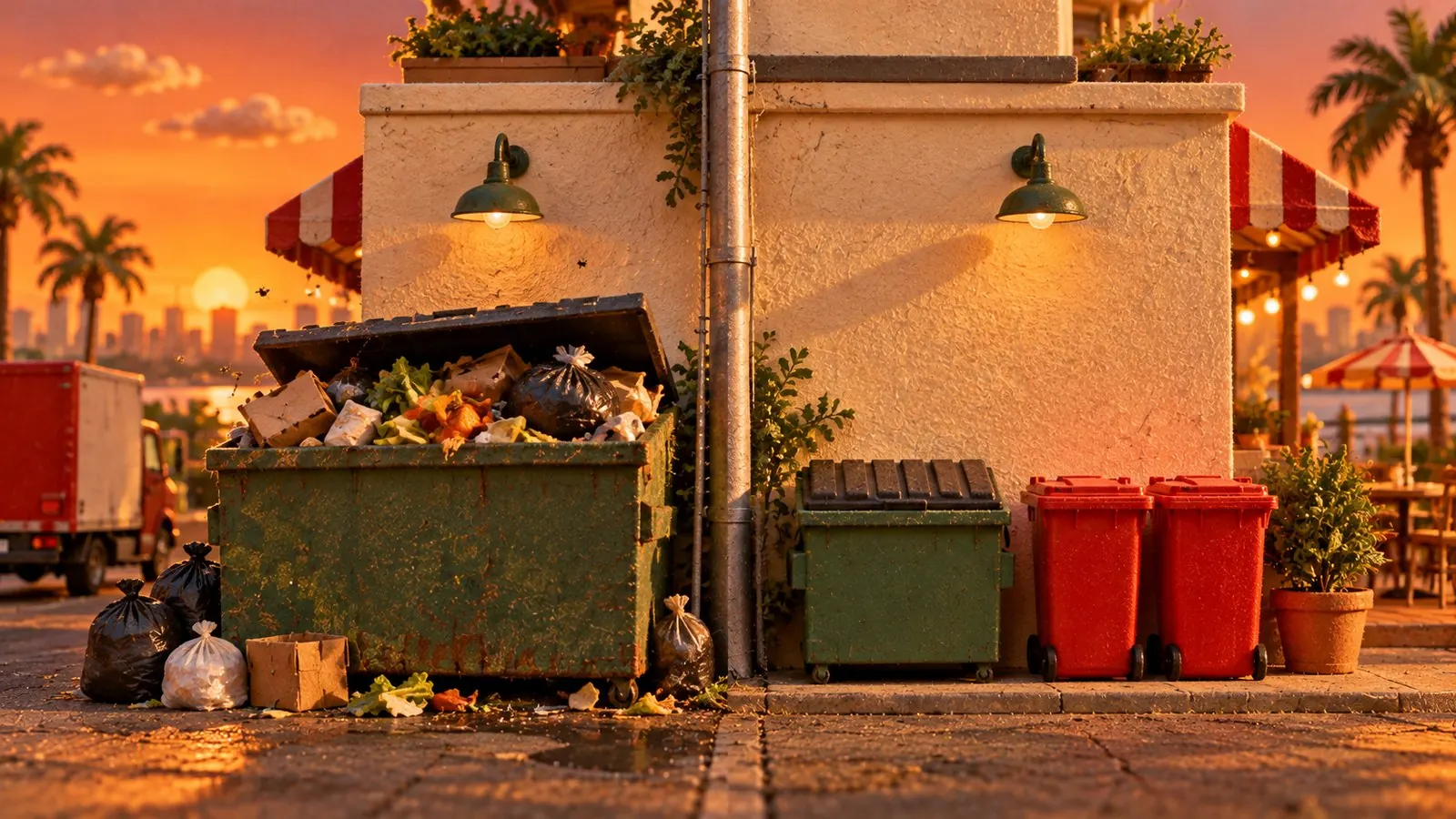
It is where the smell and the pests come from. Paper and plastic don't rot. Food does, and in Miami it does it quickly. Pulling food out of the dumpster and into a lidded bin that gets swapped for a clean one at every pickup keeps your back door from becoming a fly problem.
It is where the methane comes from. Food breaks down fast in a landfill, with no air. The EPA estimates that 58 percent of the methane that escapes from municipal landfills comes from food waste. When that same food is composted with air and heat, you get soil instead.
There is a business case too. Pricing depends on your volume, so we don't throw numbers around, but splitting out the heaviest, wettest part of your waste stream is often how a business right-sizes its regular trash service. I go deeper on that in Can composting lower your trash bill?.
Is commercial composting better than sending food to a landfill?
Yes, and it isn't close. The EPA's Wasted Food Scale ranks the ways to deal with food that goes to waste, from best to worst. Preventing waste is at the top, then donating food people can still eat. Composting sits in the middle. Landfilling and incineration are at the bottom, the options the EPA says to avoid.
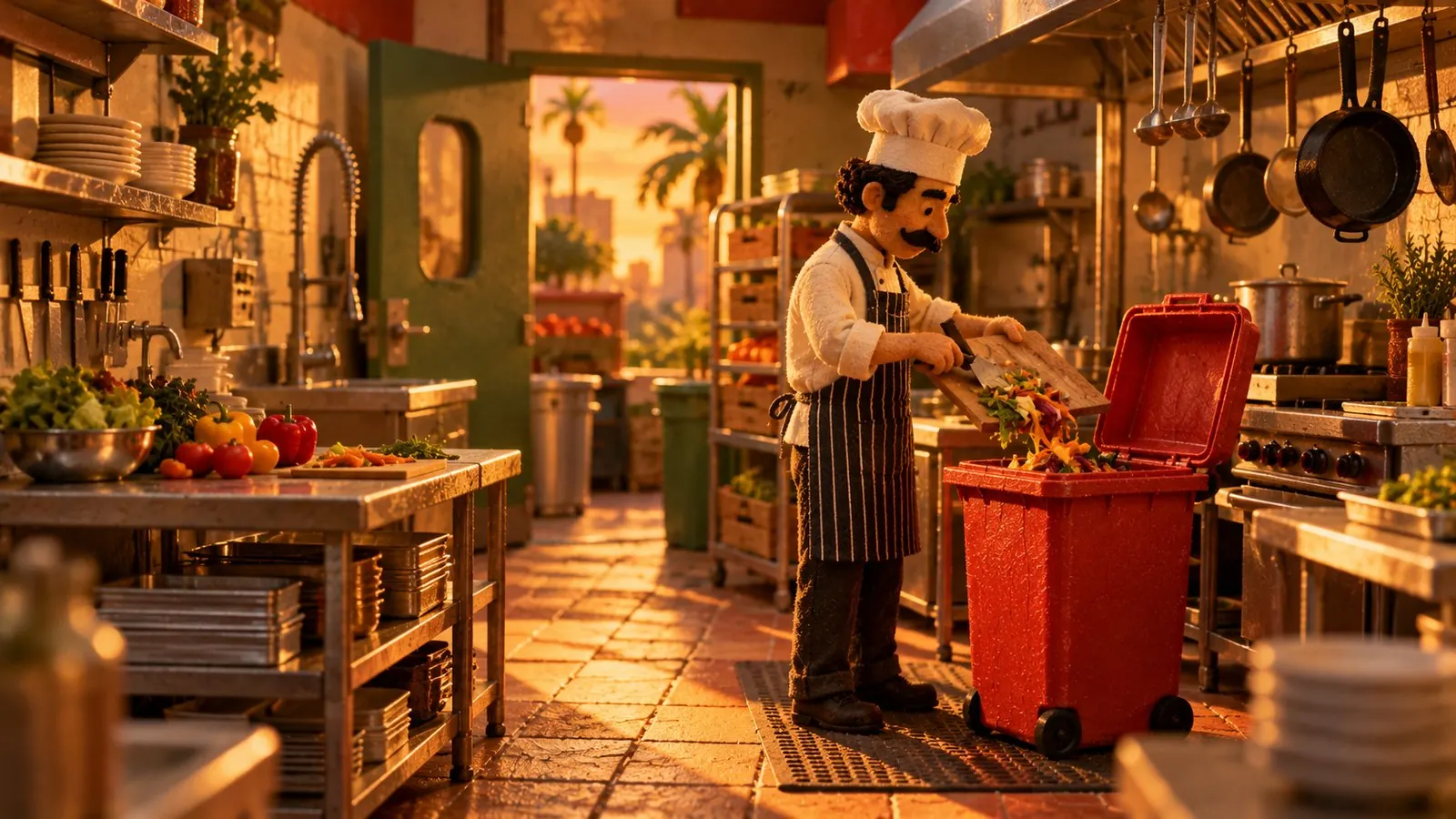
So the right order for a business is: buy and prep smart so less goes to waste. Donate what's still good. Compost the rest. A compost program actually helps with the first step too, because once your scraps go in their own bin, you can see them. A lot of chefs change a prep habit the first week they watch what fills that red bin.
What businesses in Miami can compost?
Any business that makes food waste. These are the ones we see most:
- Restaurants and cafes. Prep trimmings, plate scrapings, coffee grounds, the bread that didn't sell. ReFED estimates the U.S. foodservice sector generated 12.5 million tons of surplus food in 2024, and most of it was plate waste. If you run a kitchen, start with how restaurants can start composting.
- Hotels and resorts. Breakfast buffets, banquets, room service, staff cafeterias. Several kitchens under one roof.
- Apartment and condo buildings. Residents' kitchen scraps, collected in one spot in the trash room.
- Schools and campuses. Cafeteria lines and dining halls.
- Grocers and markets. Produce that is past selling.
- Event venues. Big bursts of food waste on a schedule you already know.
If you don't see your business here, it doesn't mean you can't. It means call us and we will walk through it.
How does commercial compost pickup work?
Here is exactly how it works with Melly's.
- Free waste audit. We come look at what you throw out, where it happens, and how much. No charge, no commitment.
- Bins go where the scraps happen. One bin size: 64 gallons, red, with a lid. You get as many as your volume needs. We put them where your team actually works, not across the parking lot.
- Pickups 1 to 3 times a week. Never less than weekly. In Miami heat, nothing should sit longer than that.
- Clean bin swap. Every pickup, we take the full bin and leave a clean one. You never wash a compost bin.
- Hot composting. Your scraps get hot-composted to EPA standards, 131 F or higher for the required time.
- Back to farms. The finished compost goes to local growers. That is the loop.
Service is month-to-month. No long contract. If it isn't working for you, you aren't stuck.
What happens to the food scraps after pickup?
They go into a hot compost pile. The pile gets built with the right mix of wet food scraps and dry, woody material so it has air and the right balance of nitrogen and carbon. Then the microbes go to work and the pile heats up on its own.
It has to hold 131 F or higher for the required time and get turned so every part of it gets hot. That is the step that makes compost safe to put on fields where food grows.
After the hot phase, it cools down and cures. What comes out is dark, crumbly, and smells like a forest floor, not like your dumpster. We sell it wholesale by the cubic yard to local growers, picked up at our yard by appointment, with delivery coming soon. Farmers use it to build up their soil. They grow food. Some of that food ends up back in your kitchen.
That's the whole point of the name on the truck. Melly's is named after my mom, Melissa, and her rule was simple: finish what you started.
How do you start a commercial composting program?
Here is the short version for a busy owner or manager:
- Find out what you throw away. Walk the back of house at close. Look in the dumpster. Or let us do it with the free waste audit.
- Decide how often you need pickups. A small cafe might be fine weekly. A busy restaurant or hotel kitchen probably needs two or three times a week. More pickups mean less smell and less space taken up.
- Count your bins. One 64-gallon bin per main station is a good starting point. We will size it with you.
- Train your team in one shift. Short rule, right placement, one owner.
- Adjust after a month. Too full? Add a pickup. Half empty? Pull a bin. Month-to-month means you can change it.
That's it. No construction, no new equipment, no shutting down service.
How do you get staff to sort food scraps correctly?
This is where programs live or die, and it is simpler than people expect.
Put the bin in the right spot. If a line cook has to walk ten steps to the compost bin and one step to the trash, the trash wins. Every time. The bin goes right next to the prep station, the dish pit, wherever the scraps actually come off the plate.
Keep the rule short. "Food goes in red. Everything else goes where it always went." That's the whole training. People don't remember long lists during a dinner rush.
Show, don't post a memo. A two-minute walkthrough at the start of a shift beats a laminated sheet nobody reads. We help with that when we set you up.
Watch the first two weeks. That is when habits form. Check the bins. If you see gloves or plastic wrap in there, fix it fast and kindly. After that, it runs itself.
Make one person the owner. Not the whole team. One sous chef, one porter, one building engineer who knows the pickup day and keeps an eye on it.
Most kitchens get it in about a week. Hotels with several outlets take a little longer because there are more doors to cover.
What is different about commercial composting in Miami-Dade and South Florida?
A lot, honestly. Miami is not Portland, and a program that works up north needs adjusting here.
The heat. Food in a dumpster in July in Miami turns fast. That is why we never go less than weekly on pickups, and why every pickup is a clean bin swap. Scraps should not sit for days in our climate, and in a closed, lidded, swapped bin they don't have to.
The county is short on space for trash. Miami-Dade's Resources Recovery Facility in Doral, the waste-to-energy plant, was badly damaged by a fire in February 2023 and has been shut down since. What a new facility looks like and where it goes has been debated ever since. Trash that used to be burned there now has to go somewhere else.
There is a plan, and it is ambitious. The county has put out a Zero Waste Master Plan with 31 strategies to guide it over the coming years. The county describes zero waste as the goal of diverting 90 percent or more of solid waste from disposal, and it says the county makes more than 5 million tons of waste a year while landfill capacity keeps shrinking. Reporting on the plan put the county's current diversion rate at about 36 percent and the plan's target at nearly 80 percent over 13 years. Organics and composting are a big part of it. Food scraps are the obvious place to start.
Recycling rules already apply to businesses. Chapter 15 of the Miami-Dade County Code already requires commercial and multifamily properties to run recycling programs. Composting your food scraps is a natural next step on top of that. Check with the county on exactly what applies to your property.
The state missed its own goal. Florida set a goal in 2008 to recycle 75 percent of its municipal solid waste by 2020. The state fell short. That gap is mostly the heavy, wet stuff, and food is a big piece of it.
Tourism means a lot of food. Miami-Dade had more than 28 million visitors in 2024, according to the Greater Miami Convention and Visitors Bureau. Every one of them eats. Hotels, restaurants, cruise provisioning, events: our food waste stream is bigger than the number of people who live here would suggest.
Our soil needs it. South Florida soil is sandy in a lot of places and rocky limestone in others. Neither holds water or nutrients well. Compost helps with both. So the scraps your kitchen makes in Brickell can end up helping a grower in the Redland. That is a real loop, and it is local.
Frequently asked questions
How much does commercial composting cost in Miami?
It depends on your volume and how often you need pickups, so there is no one number. The fastest way to find out is a free waste audit and a quote. Service is month-to-month, so you can adjust it as you go.
How often do you pick up commercial compost?
Melly's picks up 1 to 3 times a week, depending on how much food waste you make. We never go less than weekly, because in Miami heat scraps shouldn't sit longer than that. Every pickup, you get a clean bin swapped in.
Can I compost meat, bones and dairy?
Yes. Because our piles are hot-composted to EPA standards, 131 F or higher for the required time, we take meat, poultry, fish, bones, dairy and eggs. Just keep the packaging out.
Will a compost bin smell or attract pests?
A closed, lidded bin that gets picked up at least weekly and swapped for a clean one is usually less of a problem than food sitting in your dumpster. The bins have lids for a reason. Keep them closed and the pickup schedule does the rest.
Do I need to sign a long contract?
No. Melly's service is month-to-month. If your volume changes, we change the number of bins or pickups with you.
Ready to get your food scraps out of the dumpster? Start with a free waste audit. We will look at what you throw away and build a plan around your business. Get a quote and we will be in touch.
Sources
- U.S. EPA: Quantifying Methane Emissions from Landfilled Food Waste
- U.S. EPA: Wasted Food Scale
- U.S. EPA: Approaches to Composting
- Cornell Law School LII: 40 CFR Appendix B to Part 503, Pathogen Treatment Processes
- ReFED: Restaurants and Foodservice
- Miami-Dade County: Zero Waste Master Plan
- Miami-Dade County: Mayor Daniella Levine Cava unveils county's Zero Waste Master Plan
- Waste360: Inside Miami-Dade County's New Zero Waste Master Plan
- NBC Miami: Miami-Dade releases proposals for new waste management site months after Doral fire
- Miami-Dade County: Commercial and Multi-Family Recycling
- Florida DEP: Florida's 75% Recycling Goal
- Greater Miami Convention and Visitors Bureau: State of the Travel and Tourism Industry, May 29, 2025
Related posts
-
 For businesses
How Restaurants Can Start Composting
One red bin at the prep station, a two-minute talk with the line, and a pickup day. Here is how a Miami restaurant starts composting without slowing service.
-
 For businesses
Can Composting Lower Your Trash Bill?
Food is the heaviest, wettest thing in your dumpster. Pull it out and you can often shrink the rest of your trash service. Here is how to tell if it works for you.