
How Compost Fixes Sandy Florida Soil
Florida sand lets water and fertilizer run straight through. Compost gives it something to hold on with. Here is how, and how much to use.
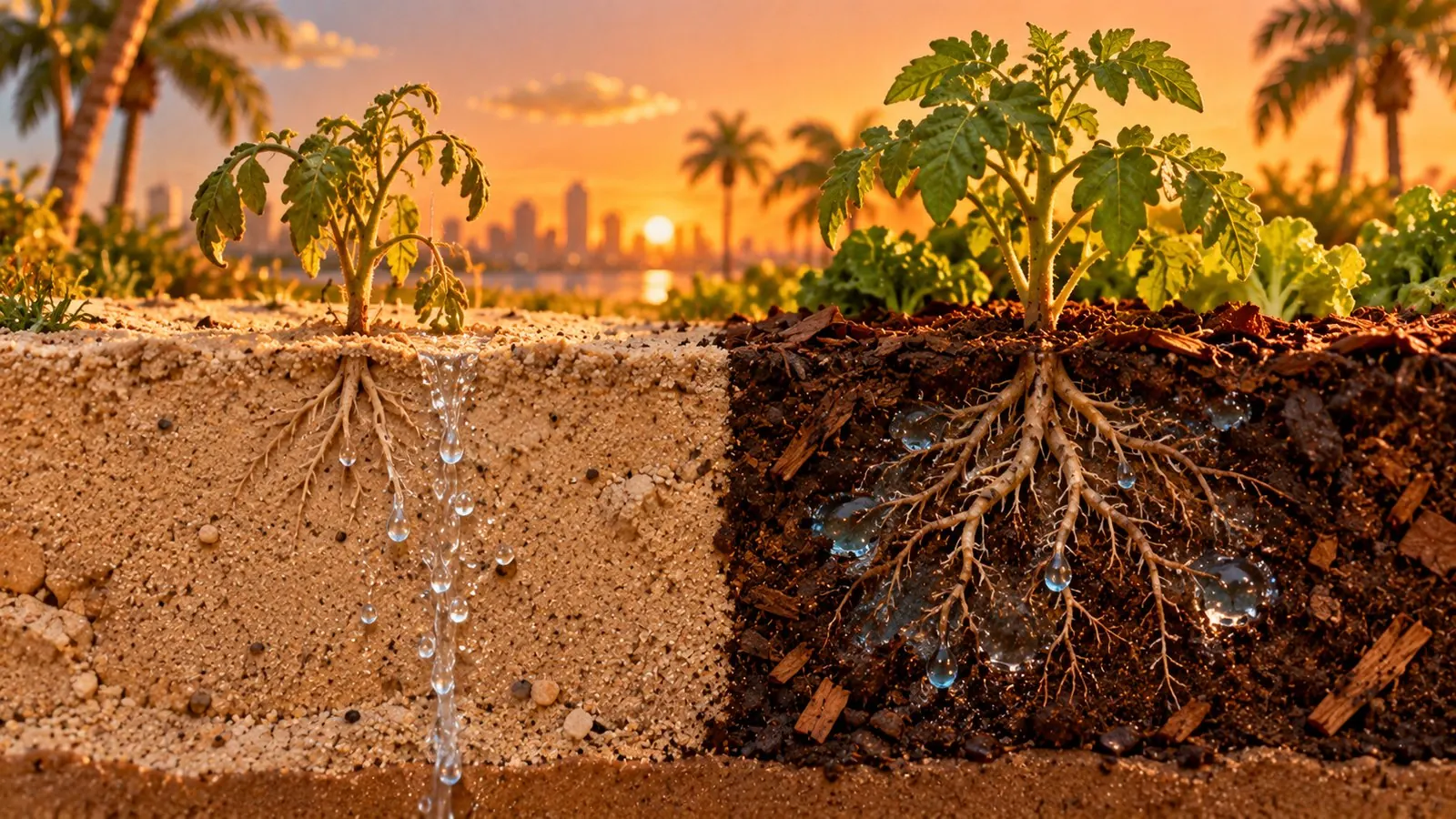
Compost fixes sandy Florida soil by adding organic matter, the thing sand is missing. Organic matter holds water and nutrients like a sponge and gives soil life something to eat, so less of your irrigation and fertilizer drains past the roots. It works best spread regularly, season after season.
Why does Florida sand drain so fast?
Sand grains are big and smooth compared to silt and clay. The gaps between them are wide, so water runs straight down, and there is very little surface for nutrients to cling to.
On top of that, our sand has almost nothing else in it. UF/IFAS Extension describes Florida soils as naturally sandy and extremely low in organic material, which leads to leaching and low nutrient levels (UF/IFAS Pasco County Extension). UF/IFAS also notes that potassium is readily leached from sandy or gravelly soils, which is why split fertilizer applications are recommended on them (UF/IFAS Extension).
So you water, it drains. You fertilize, a share of it goes with the water. That is the problem compost is built to solve.
How does compost help sandy soil hold water?
Organic matter soaks up water and holds it between the sand grains, where roots can reach it.
The research backs this up. A UF/IFAS study mixed organic matter into Florida sand and limerock in steps and measured the results. Every 1% increase in organic matter raised the water holding capacity of the sand by 2.3% (UF/IFAS Extension). That same publication cites a USDA NRCS estimate that each 1% gain in organic matter can let soil hold up to 20,000 more gallons per acre. NRDC worked through that math and found it depends on assumptions, so read it as a ceiling (NRDC).
University of Nebraska water specialists put it another way: in a medium-textured soil, 1% more organic matter holds roughly 3,400 more gallons per acre in the top foot, and the gain is proportionally larger in sandy soils, where water holding capacity starts so low (University of Nebraska-Lincoln Water).
The exact number on your farm depends on your soil and depth. The direction does not. If you want to know what that means for your pump hours, read does compost reduce irrigation.
Does compost help sandy soil hold nutrients?
Yes, in two ways.
First, organic matter has a lot of surface area and charge, so it holds on to nutrients that would otherwise wash through sand. Second, compost carries its own nutrients and releases them slowly as soil life breaks it down. The US EPA lists slow nutrient release, better soil structure and more beneficial soil organisms among the benefits of using compost (US EPA).
That slow release is a feature, not a flaw. Quick-release fertilizer on bare sand can be gone after a few heavy rains. Compost keeps feeding a little at a time. It does not replace your fertilizer program, but it helps that program stay in the root zone.
How much compost should you add to sandy soil?
Start with the soil test, then do the math. One inch of compost over an acre is about 134 cubic yards. A quarter inch is about 34. Most farms on sand do better with moderate rates every season than one heavy dose.
Work it into the top few inches before you form beds, or band it where the bed will sit so the compost ends up under the crop. For trees, spread it under the canopy out to the drip line. For a step-by-step rate calculation, see how much compost per acre.
How long does it take compost to improve sandy soil?
You will often see beds hold moisture better in the first season. Real, lasting gains in organic matter take years of steady applications, because soil life keeps eating what you add. That is normal. It is also why we tell growers to think of compost like a regular input, not a one-time project.
Track it. Pull a soil test at the same time each year and watch the organic matter number. That is the scoreboard.
Sandy soil in Miami-Dade and South Florida
South Florida has two kinds of tough ground. Along the coastal ridge and much of the county, it is sand. Out in the Redland and Homestead, it is rock-plowed limestone with a thin layer of soil on top. Both are low in organic matter, and both drain fast. If you farm on the rock, our post on compost for rocky and limestone soils is the one for you.
The weather works against you, too. Long hot summers and heavy afternoon rain keep soil life busy and push water through sand quickly. That is exactly why regular compost pays off here: you are topping up what the heat and rain take every year.
For the bigger picture on soils, timing and buying, start with our grower's guide to compost for South Florida farms.
Frequently asked questions
Is compost good for sandy soil?
Yes. Sand lacks organic matter, and compost adds it, which helps the soil hold more water and nutrients. UF/IFAS research found water holding capacity in sand rose with every percent of organic matter added.
Should I use compost or topsoil on sandy ground?
Compost. Some topsoil is mostly sand itself, so check what you are buying. Compost brings organic matter, which is the piece sand is missing.
Can I add too much compost to sandy soil?
You can. Very heavy rates can bring more salts and nutrients than your crop needs, and it is wasted money. Go by your soil test and the compost's lab analysis, and build up over several seasons.
How often should I add compost to sandy soil?
Most growers add it once a year before the main planting. In South Florida's heat, organic matter breaks down quickly, so regular applications keep the gains.
If you farm on sand in Miami-Dade and want local compost made from Miami-Dade food scraps, get wholesale pricing. We sell by the cubic yard, pickup at our yard by appointment, with delivery coming soon. See what we make on our soil page.
Sources
- UF/IFAS Pasco County Extension: Soil Amendments, Why are they important?
- UF/IFAS Extension: Calcareous Soils in Miami-Dade County
- UF/IFAS Extension: Raising Soil Organic Matter Content to Improve Water Holding Capacity
- NRDC: Organic Matter Can Improve Your Soil's Water Holding Capacity
- University of Nebraska-Lincoln Water: The connection between soil organic matter and soil water
- US EPA: Benefits of Using Compost
Related posts
-
 For farmers
Does Compost Reduce Irrigation?
Compost will not make it rain. It does help your soil hold on to the water you already paid to pump. Here is what the research says and how it plays out in Miami-Dade.
-
 For farmers
Compost for Rocky and Limestone Soils
Rock-plowed limestone gives roots a few inches to work with. Compost will not turn rock into loam, but it makes those inches count.