
Compost for Nurseries and Potting Mixes
Good compost can replace part of the peat and bark in a container mix. Too much, or the wrong compost, and plants suffer. Here is where the line is.
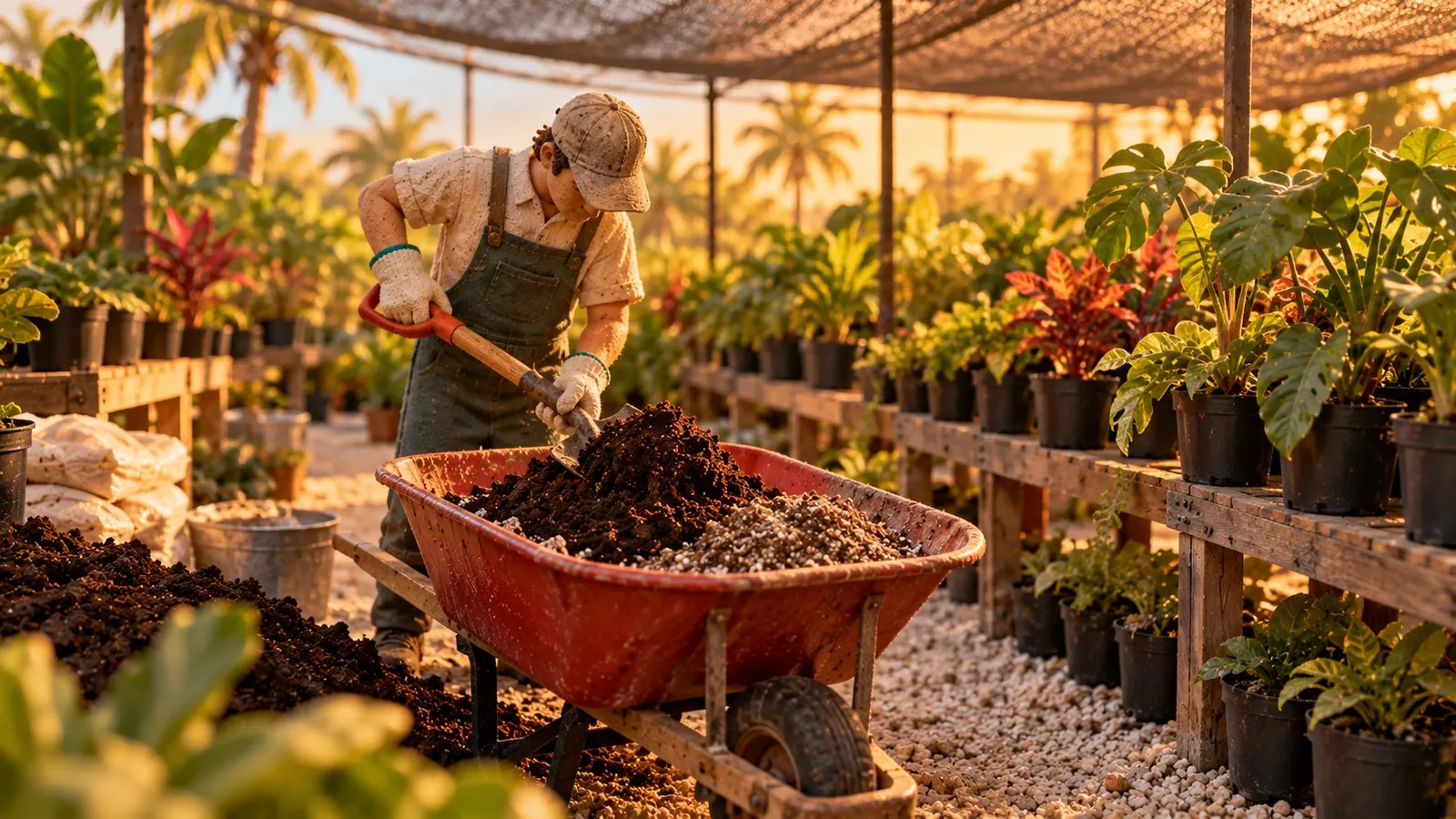
Yes, compost works in nursery potting mixes, as long as it is mature and makes up only part of the blend. Extension research generally puts compost at about 20% to 33% of a container mix by volume for most crops, with the rest peat, bark or other components. Test the compost first, then test it on a few benches before you switch a whole crop.
Can you use compost in a nursery potting mix?
Yes. UF/IFAS researchers grew foliage plants in container substrates built with compost and found several blends produced high-quality plants. Their control mix was 50% sphagnum peat and 50% pine bark. The best compost blends used compost from municipal solid waste or yard trimmings mixed with biosolids at 20%, or composted yard trimmings at 50% or less, with equal parts peat and pine bark making up the rest (UF/IFAS Extension).
UF/IFAS vegetable work points the same way for transplants. Seedlings did as well as in traditional peat and vermiculite media when compost replaced part of the peat. Pure compost media hurt growth, especially when the compost was immature (UF/IFAS).
So the answer is yes, as part of a mix.
How much compost should go in a potting mix?
Here is what extension guides say:
- University of Maryland: no more than 20% by volume for bedding plants and vegetable transplants, and up to 33% for crops like foliage plants, poinsettias and container nursery stock. It also recommends that every blend contain at least 10% peat moss (University of Maryland Extension).
- Utah State University: 20% to 33% compost, depending on the species and other ingredients, and never 100% compost because the soluble salt level is too high (Utah State University Extension).
- University of Vermont: 20% to 50% compost by volume for organic growers, adjusted for crop, container size and conditions (University of Vermont).
A sensible place to start: around 20% for seedlings, plugs and bedding plants, up to about a third for foliage and woody nursery stock. Then let the plants tell you.
What should you check before using compost in containers?
In a field, a few problems in the compost get diluted by a lot of soil. In a pot, there is nowhere for them to go. Before you blend, look at:
- Maturity and stability. Immature compost can tie up nitrogen and stunt young roots. The UF/IFAS transplant work saw the worst results with immature compost.
- Soluble salts. Measured as electrical conductivity. High salts burn roots, and they matter most for seedlings and salt-sensitive crops.
- pH. Check it against what your crop wants, and remember any lime or other additives in the rest of the mix.
- Particle size. Screened, fine compost blends evenly. Big chunks make a patchy mix.
- Weed seeds and pathogens. Compost that reached high enough temperatures for long enough should be clean. Ours is hot-composted to EPA standards, 131 F or higher for the required time.
All of that is on a good lab report. If you have never read one, our guide on how to read a compost lab report walks through each line. Ask us for our latest results before you order.
How does compost change drainage and air space?
Compost particles are finer than bark, so they fill gaps and hold more water. That can be a good thing in a fast-draining bark mix. Push it too far and the pot stays wet and short on air.
Clemson researchers tested pine bark mixes with 20%, 40% and 60% composted poultry litter and found that raising the compost share reduced both aeration porosity and total porosity (Clemson University). In practice: as you add compost, you may want coarser bark, fewer irrigation cycles, or both.
How do you blend compost into a nursery mix?
- Start with your current mix. Swap compost in for part of the peat or bark, not on top of everything.
- Measure by volume. Use the same bucket or loader scoop for every ingredient so the ratio holds.
- Blend evenly. A mixer is best. On a small scale, turn it on a clean slab until the color is even.
- Check moisture. Compost and peat behave differently when dry. Get the blend lightly moist before potting.
- Run a test block. Pot a few benches, grow them alongside your standard mix, and compare roots, color and watering needs before you change the whole crop.
- Adjust fertilizer. Compost brings some nutrients. Your fertilizer program may need tuning, not replacing.
Nurseries in Miami-Dade and South Florida
Nurseries are a big deal here. According to the 2022 Census of Agriculture, Miami-Dade County ranks first in Florida for sales of nursery, greenhouse, floriculture and sod (USDA NASS). Palms, crotons, foliage and tropical fruit trees fill benches from Homestead up through the county.
South Florida nursery mixes are their own thing, too. UF/IFAS work on south Florida nursery substrates used a ready-to-use comparison mix of Florida peat, pine bark and hardwood at 40%, 35% and 25% (UF/IFAS Extension). Compost can take over part of those ingredients, and it comes from right here instead of being trucked in.
Heat and heavy summer rain mean containers here dry out fast, then get soaked. A mix that holds some water without staying soggy is worth a lot, and that balance is exactly what you tune with the compost share.
For field use, soils and buying, read our grower's guide to compost for South Florida farms. If you also topdress field blocks, see how much compost per acre.
Frequently asked questions
Can I use 100% compost as potting soil?
No. Pure compost tends to be too high in salts, holds too much water and leaves too little air. Extension guides keep it to a share of the mix, usually 20% to 33%.
What kind of compost is best for potting mixes?
Mature, stable, screened compost with low to moderate soluble salts. Ask for a lab report that covers maturity, salts, pH and particle size.
Does compost replace fertilizer in containers?
No. Compost adds some nutrients, but container crops usually still need a fertilizer program. Tune it after you see how plants respond.
Will compost bring weeds into my nursery?
Properly hot-composted material should not. High temperatures held for the required time kill weed seeds and pathogens. Ask your supplier how their process gets there.
Run a nursery or grow in containers in South Florida? Get wholesale pricing for compost made from Miami-Dade food scraps. We sell by the cubic yard, pickup at our yard by appointment, with delivery coming soon. See what we make on our soil page.
Sources
- UF/IFAS Extension: Compost-formulated Media for Foliage Plant Production
- UF/IFAS: Compost and manure use in vegetable production
- University of Maryland Extension: Compost for Plants (FS-501)
- Utah State University Extension: Using Compost in Utah Gardens
- University of Vermont: Potting Mixes for Organic Growers
- Clemson University Extension: Composted litter in potting media
- USDA NASS: 2022 Census of Agriculture County Profile, Miami-Dade County
- UF/IFAS Extension: Moisture Retention and Chemical Properties of Nursery Potting Substrates
Related posts
-
 For farmers
How to Read a Compost Lab Report
A compost lab report looks like a wall of numbers. Six lines tell you almost everything. Here is how to read them before a yard of anything hits your field.
-
 For farmers
Compost for South Florida Farms: The Grower's Guide
Sandy ground, rock-plowed limestone, hard sun. Here is how compost earns its place on a South Florida farm, how much to use, and how to buy it by the yard.