
How to Start an Apartment Composting Program
Residents keep asking for composting. Here is how a Miami property manager sets it up in the trash room, gets people using it, and keeps it clean in our heat.

To start an apartment composting program, put lidded compost carts in the trash room or enclosure where residents already take their garbage, give each unit a small kitchen caddy and a one-page guide, and book a hauler who picks up at least weekly and swaps in clean carts. The property manager's job is mostly setup and reminders. Residents do the sorting, and most of them already want to.
Why start a composting program in an apartment building?
Residents ask for it. When Miami-Dade ran public workshops for its Zero Waste Master Plan, residents said they wanted composting options, and the county has been piloting new composting approaches in response. Renters and condo owners who composted somewhere else don't want to throw food in the trash here.
Most programs skip apartments. Researchers at the Rochester Institute of Technology point out that most food scraps programs focus on single-family homes. Multifamily buildings get left out, which is exactly why a building that offers it stands out.
Food is a big piece of the trash. The EPA estimates food is about 24 percent of what goes into U.S. landfills, and that food waste is behind 58 percent of the methane that escapes from them. In a building, that food is also what makes the trash room smell.
Where should compost carts go in an apartment building?
Where residents already take their trash. That's the most important decision you'll make.
- Trash rooms on each floor or at the chute. If your building has chute rooms, a small bin there that staff empty into the main carts works well.
- Central trash enclosure. For garden-style communities, carts go inside the dumpster enclosure, right next to the trash.
- Not across the parking lot. If composting is a separate trip, participation drops.
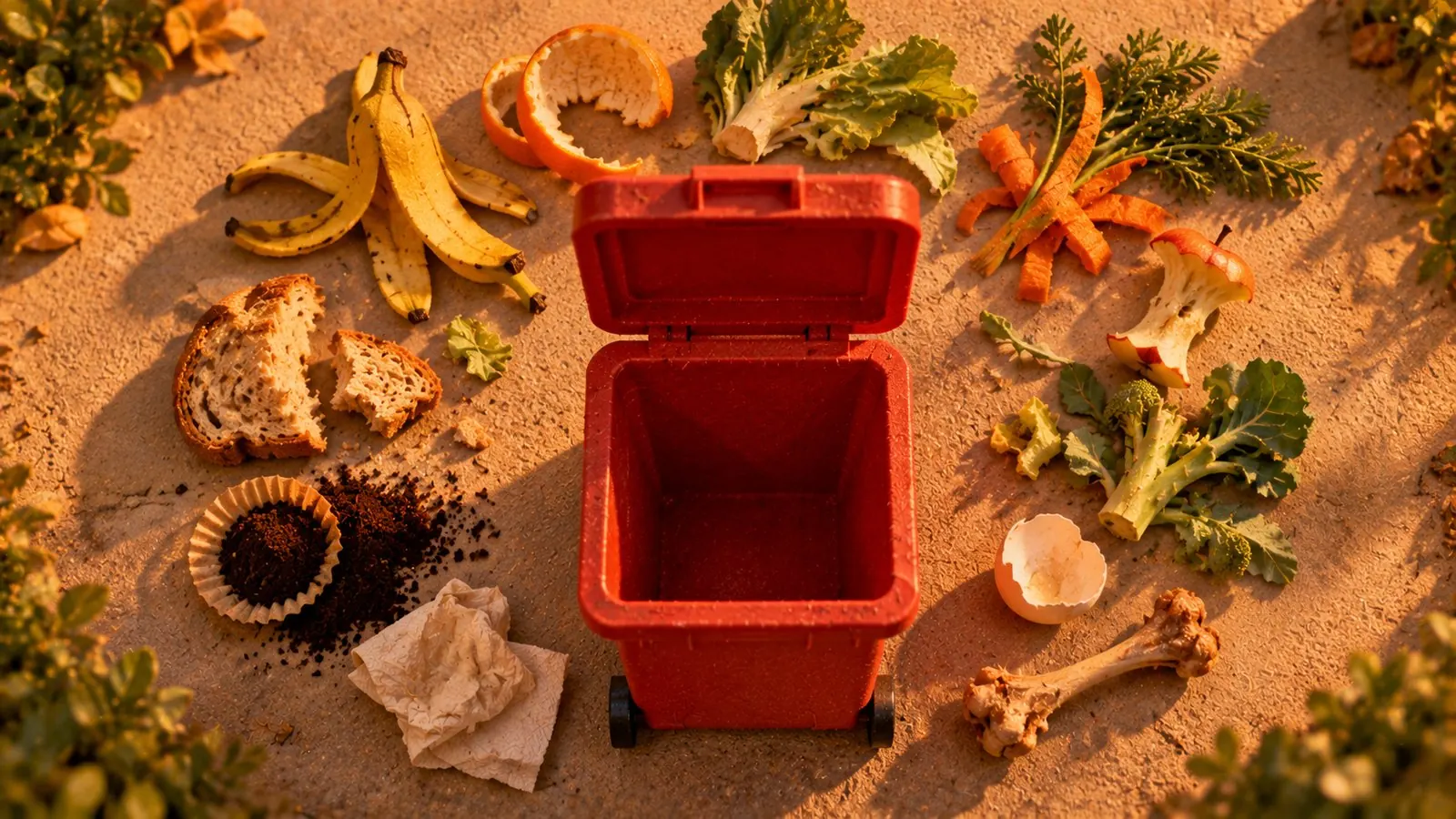
Melly's uses one cart size: 64 gallons, red, with a lid. Red stands out next to the trash and recycling, which helps residents remember which is which. You get as many carts as your building needs, and we'll help you figure that out with a free waste audit.
What do residents need to compost at home?
Two things: a container and clear instructions.
A kitchen caddy. A small lidded bin that sits on the counter or under the sink. Residents fill it while cooking and empty it into the cart when they take out the trash. Austin's multifamily composting program suggests keeping scraps in a lidded collector and even refrigerating them until trash day, which is a good tip in our heat too.
A simple guide. One page, mostly pictures. What goes in, what stays out, where the carts are, and what day they're picked up. Put one in every unit, one on the trash room door, and one in the welcome packet for new move-ins.
With Melly's, residents can put in all food scraps: fruit and vegetable scraps, meat, bones, fish, dairy, eggs and eggshells, bread, rice, coffee grounds. We hot-compost to EPA standards, 131 F or higher for the required time, so meat and dairy are fine. Plastic bags, takeout containers, foil and anything that isn't food stay out. For the full list, see what can go in a commercial compost bin.
How do you get residents to actually use it?
A building program grows slower than a restaurant program, because you're asking a few hundred people to build a habit instead of one kitchen crew. Here's what works.
- Launch it. A short note, a caddy at the door, and a launch week. Make it feel like an amenity, not a rule.
- Find your champions. Every building has a few residents who already compost. Ask them to help answer neighbors' questions.
- Keep the message short. "Food scraps go in the red cart." That's it.
- Remind people. A note in the monthly newsletter, a sign on the trash room door, a reminder for new move-ins.
- Watch for plastic. The biggest problem in apartment programs is plastic bags. People bag their scraps out of habit. Remind them to dump the caddy and keep the bag.
Expect participation to build over the first few months. That's normal.
How often should apartment compost be picked up?
At least weekly. In Miami, never less.
Melly's picks up 1 to 3 times a week depending on how much your building makes. A small building might be fine weekly. A large tower with a few hundred units will want more. Every pickup, we take the full carts and leave clean ones, so your maintenance team never washes a compost cart.
Service is month-to-month. Start small, see how residents take to it, and add carts or pickups as participation grows.
Apartment composting in Miami-Dade: what to know
Recycling is already required. Chapter 15 of the Miami-Dade County Code requires multifamily properties to run a recycling program. Composting fits right alongside it. Check with the county on exactly what applies to your property.
Buildings use private haulers. In the City of Miami, for example, properties with more than four units arrange their own garbage and recycling service with a private, city-approved hauler. Adding compost pickup is a decision you can make on your own.
The heat. A full compost cart sitting in a hot enclosure for two weeks is a problem anywhere, and in Miami it's a bigger one. Lids closed, weekly pickups at minimum, and clean carts swapped in every time.
The county is heading this way. Miami-Dade's Zero Waste Master Plan is aimed at diverting a lot more of the county's waste from landfills by 2040, with composting and organics as part of the plan. Buildings that start now are ahead. For the bigger picture across every kind of property, read our guide to commercial composting in Miami.
Frequently asked questions
Does an apartment composting program make the trash room smell worse?
Usually the opposite. Food is what makes a trash room smell, and moving it into lidded carts that get swapped for clean ones at least weekly keeps it contained. Keep the lids closed.
Can residents use compostable bags in the cart?
Ask us first. Not every bag labeled compostable breaks down in a compost pile. The simplest system is to dump the caddy straight into the cart and rinse it.
How much does an apartment composting program cost?
It depends on how many units you have, how many carts you need and how often we pick up. We start with a free waste audit and give you a quote. Service is month-to-month.
Can condo associations start a program too?
Yes. Condos, co-ops and rental buildings all work the same way. The board or the manager sets it up, and residents use it.
Ready to give your residents a composting option? We'll do a free waste audit, place the carts where residents already take their trash, and set a pickup schedule. Get a quote and we'll get your building started.
Sources
- Miami-Dade County: Department of Solid Waste Management showcases innovative compost pilot to advance organics diversion efforts
- Miami-Dade County: Zero Waste Master Plan
- Miami-Dade County: Commercial and Multi-Family Recycling
- City of Miami: Garbage and Recycling
- Rochester Institute of Technology: Establishing a foundation for food scraps diversion programs for multifamily buildings
- City of Austin: Compost Like a Pro at Your Multifamily Property
- U.S. EPA: Quantifying Methane Emissions from Landfilled Food Waste
- U.S. EPA: Approaches to Composting
Related posts
-
 For businesses
What Can Go in a Commercial Compost Bin?
Commercial compost takes a lot more than banana peels. Here is what goes in the red bin, what stays out, and why.
-
 For businesses
Commercial Composting in Miami: The Complete Guide
Everything a Miami restaurant, hotel, school or building manager needs to know about commercial composting, from the first bin to the finished soil.