
How Much Compost Per Acre?
One inch of compost over an acre is about 134 cubic yards. Here is the math for any depth, how to convert to tons, and how to let your soil test set the number.
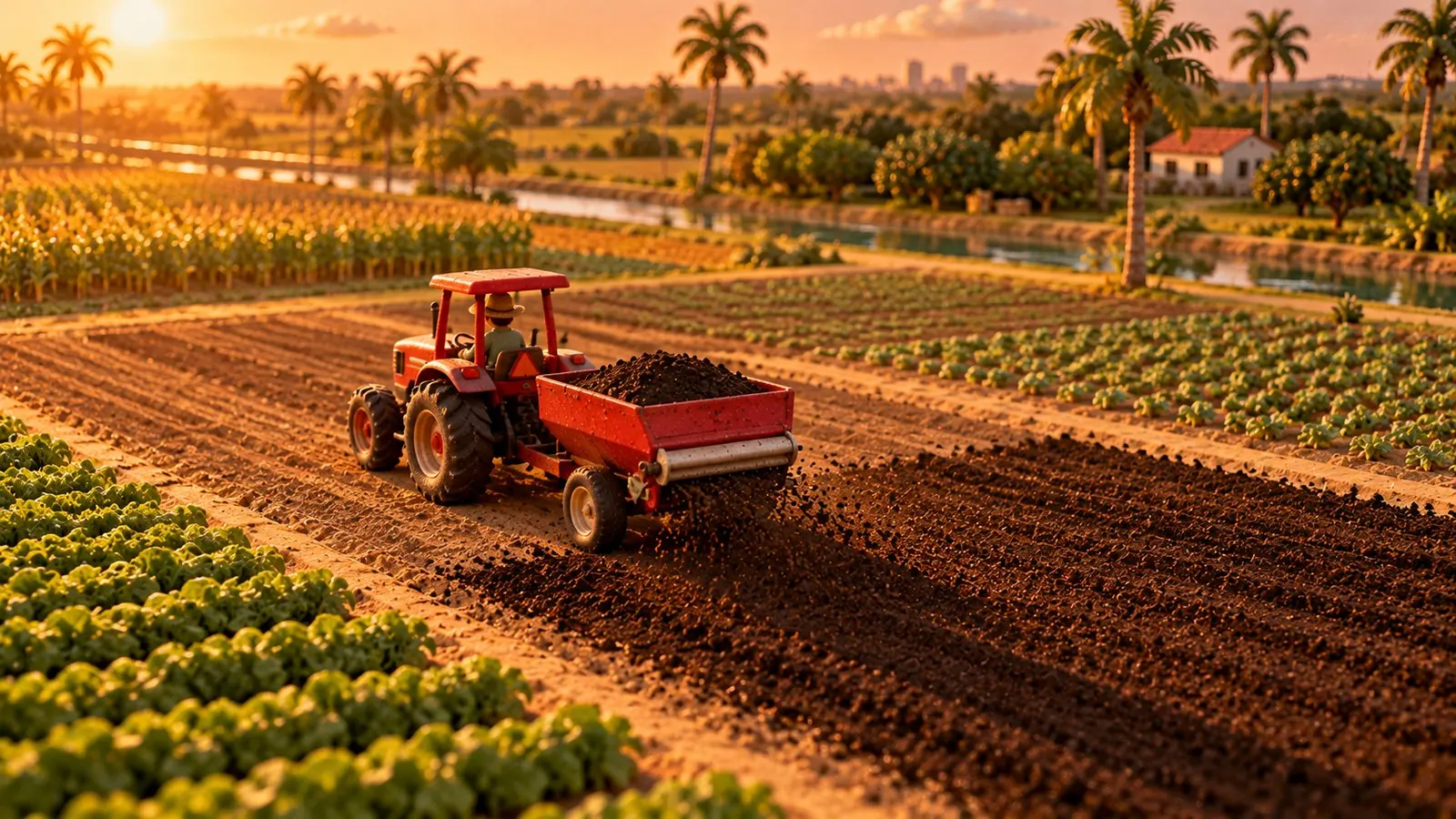
One inch of compost spread over one acre is about 134 cubic yards. A quarter inch is about 34 cubic yards and a half inch about 67. The right rate for your field depends on your soil test, your crop and the compost's lab analysis, so use the math below to plan, then let the numbers on your farm decide.
How do you calculate compost per acre?
An acre is 43,560 square feet. One inch is one twelfth of a foot. Multiply those and you get 3,630 cubic feet, and dividing by 27 cubic feet per cubic yard gives about 134 cubic yards. Caltrans uses the same figure, about 135 cubic yards per acre per inch, in its erosion control guidance (Caltrans).
So the formula is simple:
Cubic yards needed = acres x depth in inches x 134
A few quick conversions:
- 1/8 inch: about 17 cubic yards per acre
- 1/4 inch: about 34 cubic yards per acre
- 1/2 inch: about 67 cubic yards per acre
- 1 inch: about 134 cubic yards per acre
Example: a 5-acre field at a quarter inch needs about 5 x 0.25 x 134, or roughly 168 cubic yards.
How many tons of compost per acre is that?
It depends on how heavy the compost is, and that depends mostly on moisture. Caltrans assumes about 800 pounds per cubic yard, which works out to roughly 54 tons for an inch over an acre (Caltrans). Washington State University's compost guide for farmers uses 1,150 pounds per cubic yard for its conversions (WSU Extension), which would put that same inch closer to 77 tons.
That is a big spread, which is why you should ask your supplier for the bulk density on the lab report. Also check whether any rate you read in tons is wet weight or dry weight. UF/IFAS points out that compost can carry a lot of water, so the two can be very different (UF/IFAS).
How do you set a compost rate based on nitrogen?
This is the method UF/IFAS walks through for vegetables. You figure out how much nitrogen the compost will release this season, credit it, and cover the rest with fertilizer.
Their tomato example (UF/IFAS):
- Apply 10 tons of compost per acre.
- The compost is 60% dry matter and 3% nitrogen, with 10% of that nitrogen becoming available.
- 10 tons x 2,000 pounds x 0.60 x 0.03 x 0.10 is about 36 pounds of available nitrogen per acre.
- The crop needs 200 pounds, so about 164 pounds still comes from fertilizer.
That 10% is not fixed. A literature review covered by BioCycle found first-year available nitrogen averaged 6.7% of total nitrogen, ranging from composts that actually tie up nitrogen to about 24.5% (BioCycle). Your compost's lab report, especially total nitrogen and the carbon to nitrogen ratio, tells you where it is likely to land. For the bigger picture on how the two work together, read compost vs. synthetic fertilizer.
What rate should you start with?
Think in terms of goals, not a single magic number.
- Building a tired field. A heavier first application, worked in before planting, to raise organic matter.
- Maintenance. Lighter passes each season to replace what heat, rain and the crop use up.
- Trees and perennials. A topdressing under the canopy out to the drip line.
Whatever you pick, check it against your soil test and your crop's nutrient needs. Too much compost can bring more salts, phosphorus or potassium than you need, and it is money spent where it does not pay back. Start moderate, test every year, and adjust.
Should you spread compost on the whole field or just the beds?
If you grow on raised beds, you can save a lot of compost by putting it only where the beds will be. Measure the bed area instead of the whole field.
Say your beds cover 60% of a 10-acre field. That is 6 acres of bed. At a half inch, you need about 6 x 0.5 x 134, or roughly 402 cubic yards, instead of 670 for the whole field. Same result under the crop, less material in the row middles.
Compost rates in Miami-Dade and South Florida
Two things change the math down here. First, much of Miami-Dade's farmland is rock-plowed limestone with only a few inches of root zone, and a lot of the rest is sand. Both are low in organic matter and lose it fast in the heat, so moderate rates repeated each season usually make more sense than one heavy dose.
Second, our seasons. Most vegetables here go in during the cooler months, so plan your compost order for late summer into fall, ahead of bed shaping. Order early so you are not waiting on material when the field is ready. Our guide on how to buy compost in bulk covers trucks, loaders and timing.
For soils, quality and the full picture, start with our grower's guide to compost for South Florida farms.
Frequently asked questions
How many cubic yards of compost do I need for one acre?
About 134 cubic yards for one inch deep, 67 for a half inch, and 34 for a quarter inch. Multiply by your acres.
How many tons of compost per acre?
It depends on the compost's weight per cubic yard. At 800 pounds per yard, an inch over an acre is roughly 54 tons, and at 1,150 pounds it is closer to 77. Ask your supplier for the bulk density.
Can compost supply all the nitrogen my crop needs?
Usually not in the first season. Only a fraction of compost nitrogen is available right away, so most programs credit the compost and make up the rest with fertilizer.
Should I apply compost every year?
In South Florida, regular applications usually make sense, because heat and rain break down organic matter quickly. Test your soil each year to see the trend and adjust.
Know your acreage and depth? Get wholesale pricing and tell us how many cubic yards you need and when. We sell by the cubic yard, pickup at our yard by appointment, with delivery coming soon. See what we make on our soil page.
Sources
Related posts
-
 For farmers
How to Buy Compost in Bulk
Buying compost by the yard is simple once you know four things: how much you need, what is in it, how it was made, and how it gets to your field.
-
 For farmers
Compost vs. Synthetic Fertilizer
Fertilizer feeds the crop. Compost feeds the ground the crop lives in. Most good farms use both, and on sandy Florida soil the combination matters more than ever.