
How to Read a Compost Lab Report
A compost lab report looks like a wall of numbers. Six lines tell you almost everything. Here is how to read them before a yard of anything hits your field.
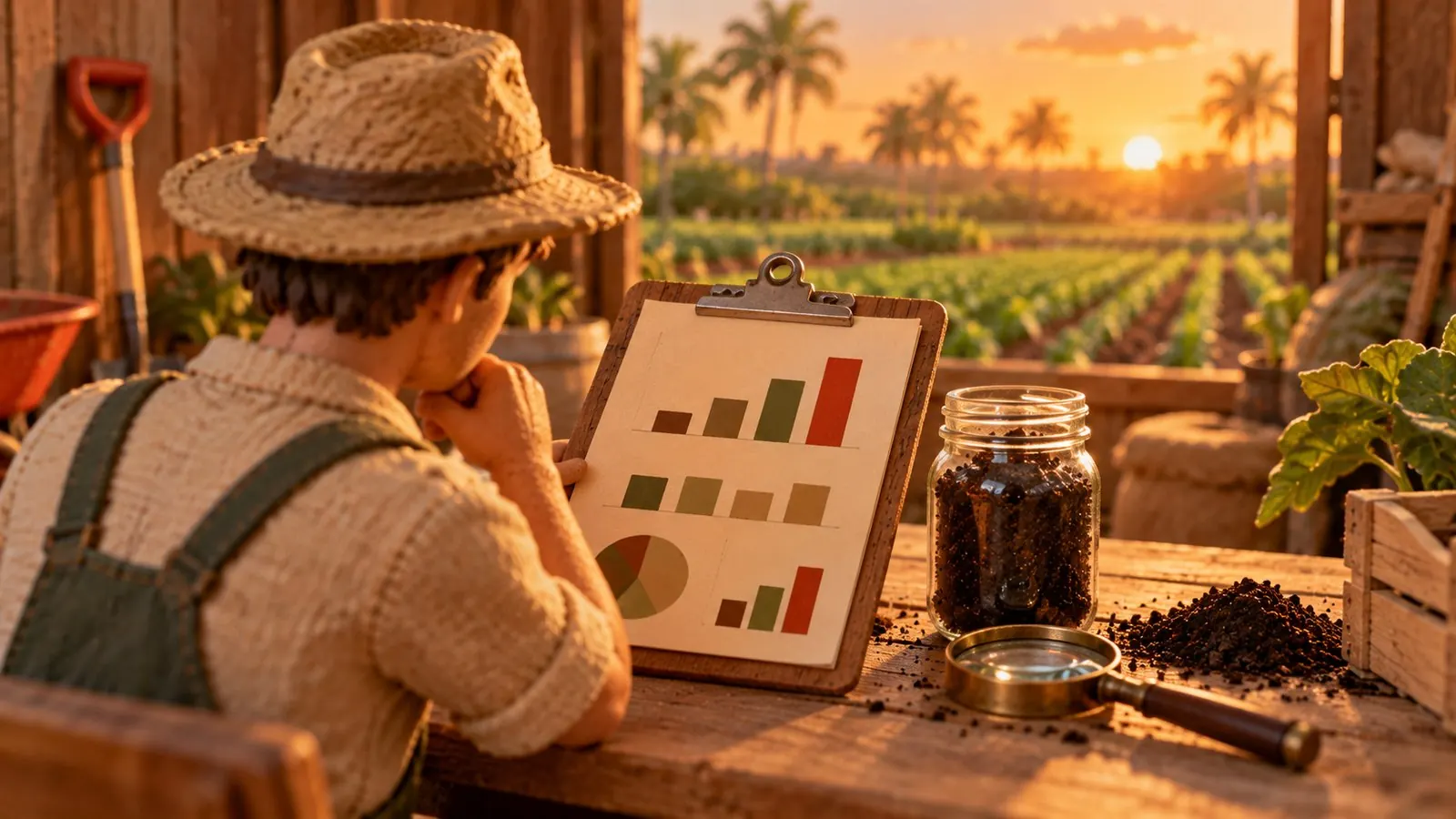
To read compost test results, start with six lines: pH, soluble salts, carbon to nitrogen ratio, moisture and organic matter, maturity, and the pathogen and metals screens. Those numbers tell you whether the compost is finished, whether it will burn young plants, and whether it is safe to put near food. Nutrient numbers matter, but they come last.
What is actually on a compost lab report?
Most compost reports in the US follow the same playbook. Labs test using the Test Methods for the Examination of Composting and Compost (TMECC), the manual the US Composting Council uses as its benchmark. Producers in the Council's testing program hand buyers a Compost Technical Data Sheet, which the Council compares to a nutrition label: test results, ingredients and directions for use.
A typical report lists:
- pH
- Soluble salts (electrical conductivity, or EC)
- Nutrients: nitrogen, phosphorus, potassium, calcium and so on
- Organic matter and moisture
- Carbon to nitrogen (C:N) ratio
- Stability and maturity
- Pathogens (fecal coliform or Salmonella) and trace metals
- Particle size and foreign matter
If you only have five minutes, read salts, maturity and pathogens. Then go back for the rest.
What pH should finished compost have?
Clemson University's agricultural service lab gives a range of 5.0 to 8.5 for finished compost, and notes that neutral, around 7, suits most uses. Food scrap compost often lands a little above neutral.
For South Florida growers on alkaline limestone ground, a high pH compost is not ideal for acid loving crops. Know your soil pH before you pick a product. If you grow in containers, pH matters more, because the compost is a bigger share of what the roots touch. We cover that in compost for nurseries and potting mixes.
How do I read soluble salts on a compost test?
This is the line that burns seedlings. Salts show up as electrical conductivity, reported in dS/m or mmhos/cm (the same thing). The US Composting Council says most composts run 1.0 to 10.0 dS/m, while typical soils sit around 0 to 1.5. Clemson uses the same 1 to 10 range and warns that high salinity can be toxic to plants.
Two things to watch:
- The method. Labs extract salts different ways. The University of Minnesota Extension points out that results from one dilution method cannot be compared with another. Check the method before you compare two suppliers.
- The use. Top dressing an established orchard can handle more salt than a seedling flat. If salts are high, Minnesota suggests mixing the compost with soil to dilute it, or letting it weather outside so rain can leach the salts out.
What C:N ratio means compost is finished?
The C:N ratio tells you how hungry the compost still is. Clemson lists 10:1 to 15:1 as typical for finished compost. Its guidance: composts above 30 tend to tie up nitrogen in the soil, and composts below 20 release plant available nitrogen.
In plain terms, a high C:N compost borrows nitrogen from your crop while it keeps breaking down. Your plants go pale and you blame the weather. A low number means the microbes are mostly done eating.
How do I know if compost is mature and stable?
Stability and maturity are two different tests.
- Stability measures how fast the microbes are still breathing, usually as CO2 released per gram of organic matter per day. Lower is more stable.
- Maturity is a plant test. The lab grows seeds in the compost and reports percent emergence and seedling vigor compared with a control. The Composting Council explains that immature compost can carry ammonia and organic acids that hold back germination and roots.
If emergence and vigor are high, the compost is ready for sensitive uses. If they are low, keep it away from your seed beds.
What do the pathogen and metals lines mean?
These are usually pass or fail. Pathogen screens check fecal coliform or Salmonella against the federal biosolids rule, 40 CFR Part 503, and metals are checked against the same rule. A pass tells you the heat did its job. For more on why heat matters for food crops, read is compost safe for vegetables?.
Moisture and organic matter round it out. Clemson's targets for finished compost are 40 to 50 percent moisture and 50 to 60 percent organic matter. Moisture matters when you buy by volume: wet compost is heavier and clumpier, dry compost is dusty.
Reading a compost report in Miami-Dade and South Florida
Down here the report has to answer South Florida questions. Our ground is either sandy and low in organic matter, or thin rocky limestone that has to be rock plowed before anything grows. In both, compost works hard, so quality shows fast.
Watch salts closely. Many of our farms sit close to the coast and some irrigation water already carries salt. Stacking a salty compost on top of that is asking for trouble on young transplants. Watch pH on the limestone. And because our heat speeds everything up, a compost that is not quite finished will keep cooking in your beds and pull nitrogen while it does. The full picture of how compost fits on our soils is in the grower's guide to compost for South Florida farms.
Frequently asked questions
How often should compost be tested?
Every batch is a little different because the food going in changes with the season. Producers in the Composting Council's program test on a set schedule, so ask any supplier how recent the report is. A report from years ago tells you very little about the pile in front of you.
Can I compare two compost reports side by side?
Only if both labs used the same methods. Salts in particular change with the extraction method. When in doubt, ask the supplier which TMECC method the lab ran.
Are the nutrient numbers a fertilizer guarantee?
No. Technical data sheets usually say the nutrient values are for information only, not a guaranteed analysis. Compost releases nutrients slowly, so plan your fertility program with a soil test too.
Does Melly's share lab results?
Yes, ask us for the latest numbers on our compost when you request wholesale pricing.
If you are buying compost by the yard for a South Florida farm or nursery, read the report before you load the truck. We sell our compost wholesale by the cubic yard, with pickup at our yard by appointment and delivery coming soon. Get wholesale pricing and ask for the numbers.
Sources
- US Composting Council: Test Methods for the Examination of Compost and Composting
- US Composting Council: Seal of Testing Assurance Program
- US Composting Council: Compost Characteristics and their Importance
- Clemson University Agricultural Service Laboratory: Compost Interpretations
- Clemson University Agricultural Service Laboratory: Compost Interpretation
- University of Minnesota Extension: Interpreting your compost report
- Cornell Law School LII: 40 CFR Appendix B to Part 503, Pathogen Treatment Processes
Related posts
-
 For farmers
Is Compost Safe for Vegetables?
Properly made compost is safe for vegetable beds. The word that matters is properly. Here is what heat, time and curing do, and what to ask before you spread.
-
 For farmers
Compost for Nurseries and Potting Mixes
Good compost can replace part of the peat and bark in a container mix. Too much, or the wrong compost, and plants suffer. Here is where the line is.